Curated by Juan Ortiz Freuler / Sign up / Submit contributions
🎂[Anniversary: 50 years from the NAM Colombo Declaration echoes current anxieties]

Colombo declaration (1976) excerpt:
“Non-Aligned countries noted with concern the vast and ever growing gap between communication capacities in non-aligned countries and in the advanced countries which is a legacy of their colonial past. This has created a situation of dependence and domination in which the majority of countries are reduced to being passive recipients of biased, inadequate and distorted information. The fuller identification and affirmation of their national mid cultural identity thus required them to rectify this serious imbalance and to take urgent steps to provide greater momentum in this new area of mutual co-operation.
162. The emancipation and development of national media is an integral part of the overarching struggle -tor political, economic and social independence for a large majority of the peoples of the world who should not be denied the right to inform and to be informed objectively and correctly. Self-reliance in sources of information is as important as technological self-reliance since dependence in the field of information in turn retards the very achievement of political and economic growth.
163. Non-Aligned countries must achieve these objectives through their own efforts as well as by more active co-operation on a bilateral, regional as well as inter-regional basis and by co-ordinating their activities in the United Nations and other inter national forums. It is particularly necessary for non-aligned countries to strengthen their existing intrastructure…”
See also:
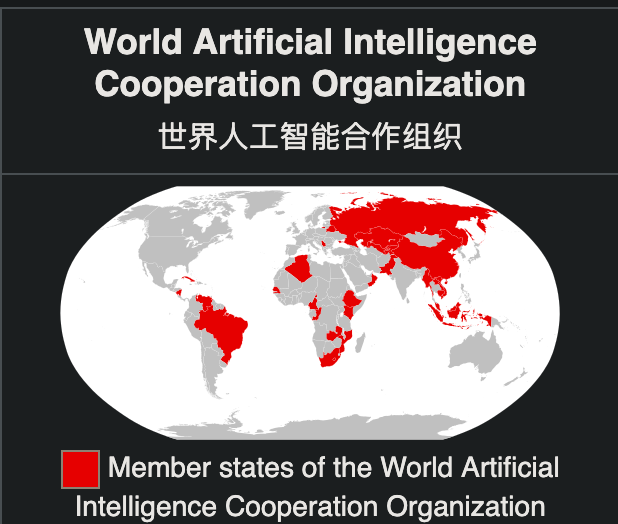
🇨🇳[NEWS: China launches World Artificial Intelligence Cooperation Organization]
Geographic reach (29 members by July 2026)
Positioning among existing AI institutions of governance
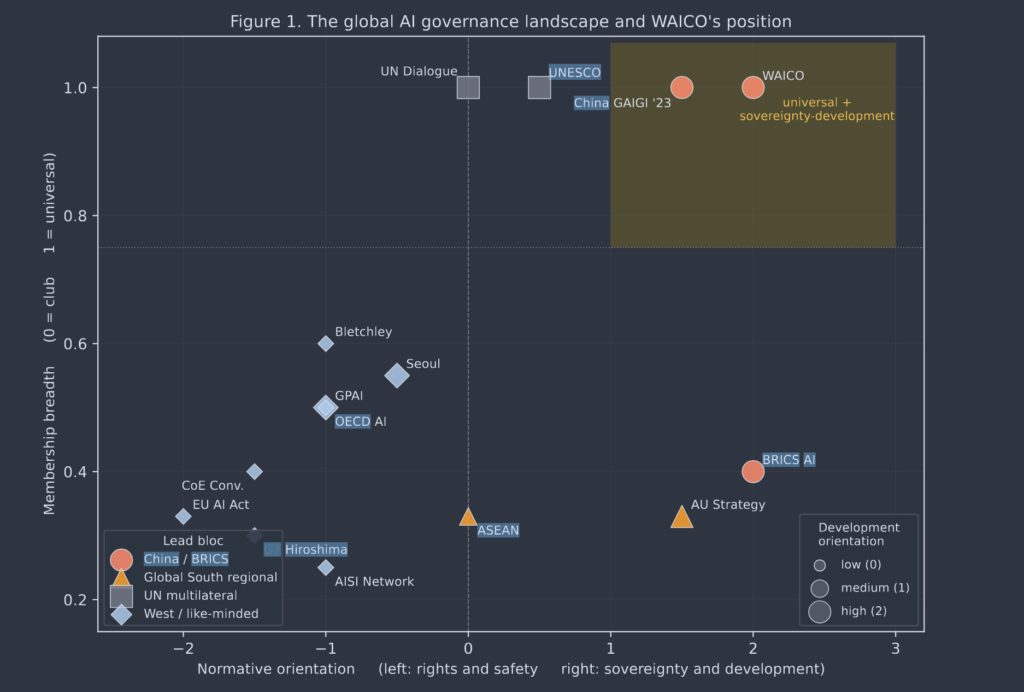
https://arxiv.org/pdf/2606.23860
[Excerpt of keynote speech by Xi Jinping]
“…we should advocate solidarity and improve global governance. AI is an invaluable asset that encapsulates humanity’s collective wisdom. We should practice true multilateralism and recognize the important role of the United Nations. We should enhance alignment and coordination on AI development strategies, governance rules and technical standards, so as to form a consensus-based global governance framework at an early date to make this frontier technology better benefit humanity. We must carry out extensive international cooperation and help Global South countries with capacity building to bridge the AI and digital divides, promote sustainable development, and prevent creating new historical injustice in AI.”
https://english.news.cn/20260717/893fe11097db460ea31b98f131e34ef0/c.html
Commentary on Xi Speech:
“Key takeaways:
1. Xi doubled-down on China’s pitch to the world on AI: We are the open, cooperative partner who wants to help you build your own capabilities.
2. Xi restated the status-quo on open-source: we should “encourage open-source AI.”
3. Xi concluded the speech with stark language on remaining ready to change course as circumstances change, and preventing “loss of control.”
https://mattsheehan.substack.com/p/xi-jinpings-big-ai-speech-annotated#footnote-3
🇨🇳[NEWS: Deepseek CEO communications leaked: Perceives China as lagging US on AI and dependent on NVIDIA chips]
“During private investor meetings, billionaire founder Liang Wenfeng reportedly dropped some candid, uncomfortable truths: China is still lagging behind the U.S. in AI sophistication, and DeepSeek remains heavily dependent on Nvidia chips despite U.S. export controls. Those remarks leaked and went viral across Chinese social media and local outlets like Yicai. In response, Bloomberg reports that a frustrated Liang verbally notified prospective backers to hold off, telling them that expected investment agreements will not be signed in the coming days. This effectively pauses a follow-on round that was targeting a staggering $71 billion (480 billion yuan) pre-money valuation”
https://finance.yahoo.com/technology/ai/articles/deepseek-hits-brakes-mega-funding-131502562.html
🇨🇳[NEWS: The secret Trump administration battle to fight Chinese AI]
“The Trump administration is showing signs it could ban cutting-edge Chinese AI models — a momentous move that could lock in dominance by OpenAI and Anthropic.
Why it matters: Parts of the administration have tried to implement de facto bans on foreign open-source models before, knowledgeable sources tell Axios. Last week’s rise of Chinese model Kimi is reigniting those efforts.
Pro-competition voices fear the implications.
- U.S. companies are increasingly using open-source models from China because they’re cheaper and, as seen by the advent of Kimi, just about as good as the domestic technology.”
https://www.axios.com/2026/07/20/ai-us-china-open-source-kimi
🇨🇳[NEWS: Chinese Supreme Court roundtable on open source and AI governance points to potential limit on open weights?]
Translation: “The unique challenge of cross-border flows of open-source AI models is that model weights implicitly encode characteristics of the training data. On one hand, when Chinese developers build upon foreign open-source foundation models, they face subtle software supply chain security risks, including the possibility that models contain embedded backdoors, malicious instructions, or hidden value biases. On the other hand, when China’s leading open-source AI projects expand internationally, a new category of cross-border data security risk emerges under the framework of the Data Security Law of the People’s Republic of China. Specifically, there are concerns that Chinese citizens’ personal data or sensitive geographic and economic data embedded in model weights could be reconstructed by foreign actors through reverse engineering. As a result, the traditional policy approach of ensuring that “data does not leave the country” must evolve into a more sophisticated regime of technical auditing to ensure the secure cross-border transfer of model weights.” – via Kyle Chan [original]
🇨🇳📡🪖[China claims to have tech to disrupt Starlink satellites operating in low Earth orbit]
“Chinese researchers have developed what they claim is the world’s first HPM weapon compact driver. This device can generate 20 gigawatts of energy for up to 60 seconds.
They believe this breakthrough could pose a threat to large Low-Earth-Orbit (LEO) satellite constellations, like SpaceX’s Starlink. The team published their findings in the peer-reviewed journal Chinese High Power Laser and Particle Beams.”
🇺🇸↔️🇨🇳[Brief: A new risk framework for Chinese technology products and investments?]
“Our current approach to addressing risks from Chinese technology is ad hoc and fragmented. New concerns seem to suddenly enter the spotlight: drones, Wi-Fi routers, port cranes, subway cars, power inverters, and connected vehicles, to name a few recent examples (see Table 1 for a more comprehensive list). The tools and procedures for dealing with these risks are scattered across the federal government: the Federal Communications Commission (FCC) “Covered List,” the Department of Defense’s (DOD) 1260H list, the Department of Commerce’s Information and Communications Technology and Services (ICTS) rule, the U.S. Trade Representative (USTR) investigation process, the Committee on Foreign Investment in the United States (CFIUS), and so on (see the appendix for a more comprehensive list). Bans are often too sudden or crude, causing unnecessary disruption to U.S. industry or consumers. Investigations often lack transparency. Multiple federal agencies and congressional bodies are duplicating efforts on issues that require a coordinated, government-wide response.
The need for a clearer framework is particularly urgent now, as the United States prepares to establish a “board of trade” and “board of investment” with China”
🇪🇺↔️🇺🇸[NEWS: Airbus is moving its most critical apps off AWS to a French cloud]
“Airbus will move 70 of its most critical applications from AWS to French provider Scaleway, part of a push for digital sovereignty that keeps sensitive data beyond the reach of US law.
[…]The systems heading to Scaleway include Airbus’s ERP, manufacturing, CRM and product-lifecycle software. They span aircraft design, engineering, manufacturing and enterprise operations.The goal is to keep that data under European control.[…]
The concern driving all this is the US CLOUD Act. It lets American authorities request data held by US firms, even in overseas data centres. Last year a Microsoft executive told a French court, under oath, that the company could not guarantee data sovereignty.
Tensions between the US and Europe have sharpened under a second Trump administration, hardening calls for digital sovereignty. AWS, Microsoft and Google have all launched “sovereign” offerings to reassure European customers.”
https://thenextweb.com/news/airbus-scaleway-aws-sovereign-cloud
🇨🇳[NEWS: “Censorship in Chinese AI models can be undone, new research shows”]
“When researchers asked a question about Uyghur detention camps in China, one of DeepSeek’s open-source AI models claimed there was no evidence they existed. When they asked an AI model created, or distilled, from that DeepSeek open-source model the same question, it said evidence shows the Chinese state held Uyghurs in “internment-type facilities.”
AI models created using open-source Chinese versions like DeepSeek’s and Moonshot’s don’t always adhere to the same censorship guidelines that the purely Chinese models follow, the researchers said in a new paper shared exclusively with Semafor.
The findings undercut one of the US government’s top concerns — that Chinese open-source AI models are a pathway for Chinese political ideas to infiltrate the views of those who use them.”
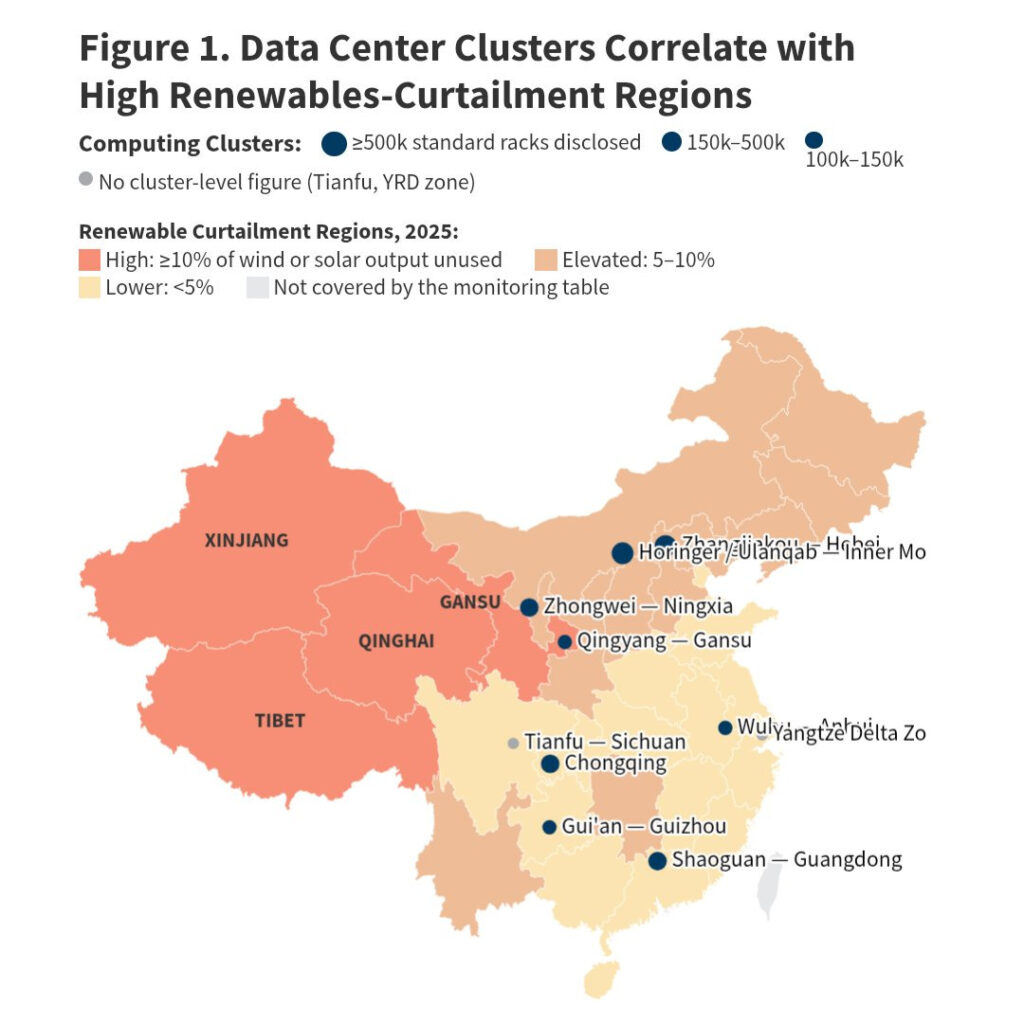
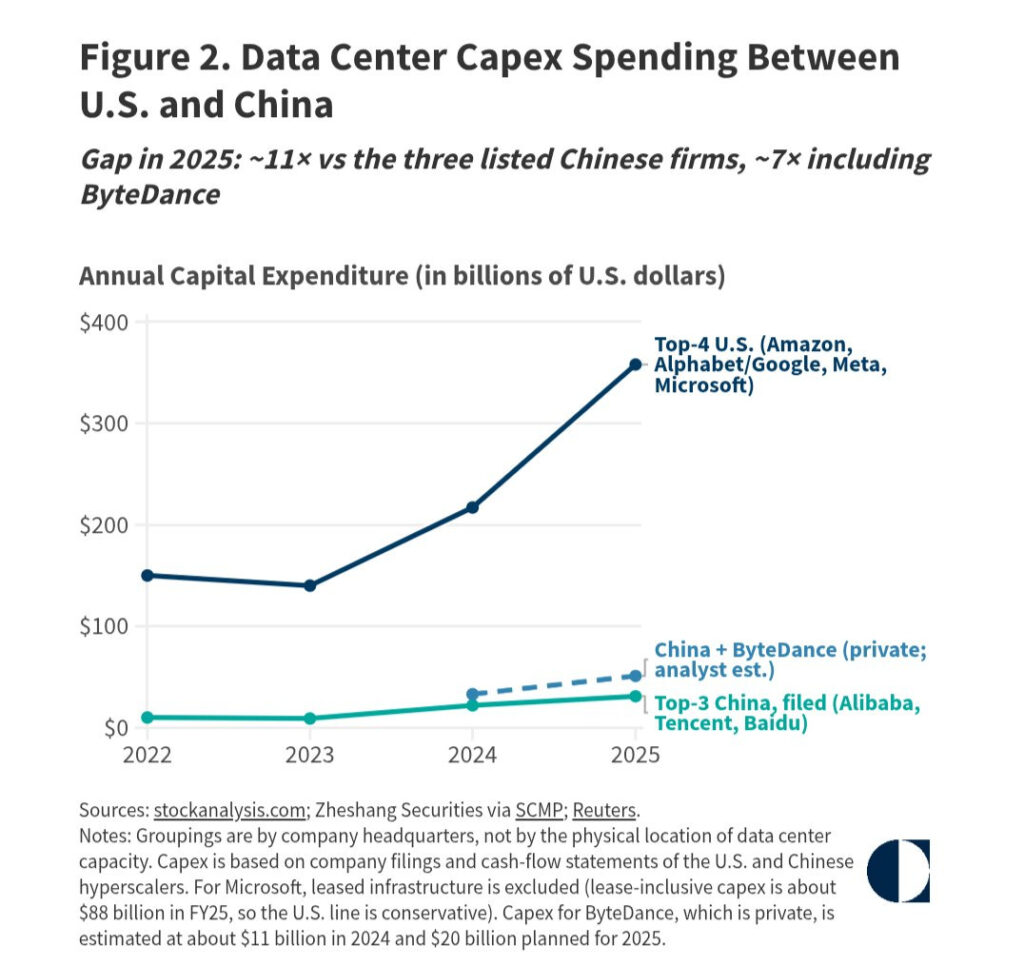
[Analysis: Data centers and renewables in China]
1. Siting of largest compute clusters correlates well with the largest renewable bases. Data centers might absorb “excess capacity”
2. Large gap between US AI capital expenditure and Chinese capex (private sector) – about 7-8x.
⛏️🌍🇺🇸[Analysis: The State Department’s $500 Million Bet To Beat China on African Minerals]
The program rests on a simple premise: Washington can’t match Beijing’s spending on African critical minerals dollar-for-dollar. Instead, it is using federal grants to lessen risk so that U.S. private capital steps in. In practice, this means soliciting project ideas from applicants and issuing up to ten grants of $5-50 million for such initiatives as geological surveys, mining-sector reforms, and deal advisory work — the kinds of upfront costs that are often too risky for the private sector”
🇨🇳🌎🇺🇸[Opinion: Strategic competition and managed interdependence]
“The Global South is no longer a peripheral arena in United States (US)-China competition. Trade, technology, industrial policy, logistics corridors, and development finance have become instruments through which strategic rivalry is projected outward. For countries across Asia, Africa, and Latin America, the challenge is no longer simply how to engage Washington or Beijing diplomatically, but how to preserve developmental autonomy in an environment where great-power competition is restructuring markets, supply chains, and industrial choices.”
🌎🇺🇸[Analysis: “The Short-Term Results and the Long-Term Risks of the “Donroe Doctrine”
“Perhaps the most striking element of Trump’s Latin America policy is not the renewed focus on the hemisphere per se, but the extent to which it so unabashedly echoes U.S. President Theodore Roosevelt’s “big stick” policy and other episodes from the past two centuries of U.S. interventionism in the region. The administration’s 2025 National Security Strategy promised that “after years of neglect, the United States will reassert and enforce the Monroe Doctrine to restore American preeminence in the Western Hemisphere,” referencing the 203-year-old idea, introduced by U.S. President James Monroe, that outside powers should not meddle in the Western Hemisphere.
Whereas previous post–Cold War U.S. administrations had mostly emphasized values such as sovereignty and mutual respect in their dealings with Latin America, Trump has threatened to “take back” the Panama Canal and conduct unilateral strikes on cartels in Mexico; publicly endorsed candidates who share his conservative, tough-on-crime views; and, in the case of Venezuela, used U.S. military might to topple a leader he did not like, as numerous presidents in the nineteenth and twentieth centuries did.”
https://www.foreignaffairs.com/americas/trump-remaking-latin-america
🏘️ [ANALYSIS: Data collectives as an alternative to big tech]
“Communities that possess smaller or unusual data sets can gain from having control over them, Raffi Krikorian, chief technology officer at Mozilla, told Rest of World. The nonprofit last year set up Mozilla Data Collective to provide a platform for such data sets from communities, organizations, and individuals around the world. “More people are starting to feel like they’re sitting on unique information, not generally available on the internet, and they want to turn the tables on what governance looks like for that data,” Krikorian said.
https://restofworld.org/2026/ai-data-collectives-mozilla
🇮🇳 [Opinion: former foreign secretary of India sees diverging US-China AI stacks as leading towards fragmentation and pressures]
“The United States and China are the undoubted leaders in AI, but they have pursued different development strategies. The United States has adopted a proprietary approach, licensing each generation of AI and raising revenue from its users. China’s strategy is to make its AI offerings open-source, permitting rapid diffusion across the whole spectrum of economic and military activity and enabling productivity gains throughout its economy. If the American emphasis is on cutting-edge research, the Chinese focus is on application. The Chinese “stack” is likely to prove the more attractive and cost-effective proposition for the countries of the Global South, particularly those tied more closely to the Chinese economy through the Belt and Road Initiative (BRI). The U.S. stack, though more advanced, will carry greater currency among America’s network of allies and partners—especially those where the major U.S. technology companies, such as Meta, Google, Amazon, Microsoft, and Apple, are already entrenched.
These rival stacks are likely to grow increasingly incompatible with one another and may force the large constituency of developing countries to choose between them. Neither side is likely to grant access to its most sensitive and most powerful versions (… )
For countries like India, the hope of remaining in the AI game is reinforced by the “fast follower” phenomenon, which requires some explanation….”
🇧🇷🧱[Brazil’s key foreign policy advisor argues for non-alignment via BRICS]
“We must recognise that neither Latin America nor Europe is leading the artificial intelligence race. What we see today are two poles, the United States and China,” Amorim said, adding that the gap will have practical consequences as technology “multiplies power, asymmetries and is never neutral”.
Brazil’s answer, in his telling, is to pick neither side but to draw capital and technology from both.”
🇺🇸🇨🇳[Analysis: America Leads, China Is Catching Up, Europe Is Falling Behind]
“An analysis by Valentin Weber for the FNF Global Innovation Hub in Taiwan shows who actually provides the most important AI chat applications and which countries they come from. The publication “The Geopolitics of AI App Exports” evaluates the download figures of generative AI apps on Android devices, from their respective market launches through the end of April 2026. The result is worrying for Europe.”
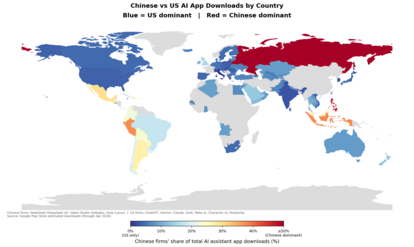
Full report: https://shop.freiheit.org/#!/Publikation/2132
🇮🇩[News: Indonesia President insists on upholding non-aligned foreign policy]
“President Prabowo Subianto reaffirmed that Indonesia will continue to uphold its long-standing free and active foreign policy by maintaining a non-aligned position amid rising global geopolitical tensions.
Speaking at a meeting with business leaders from the Indonesian Chamber of Commerce and Industry (Kadin) at the State Palace in Jakarta on Friday, Prabowo said Indonesia had inherited its foreign policy principles from the nation’s founding fathers, emphasizing that the country does not align itself with any military bloc or alliance.”
https://en.antaranews.com/amp/news/424861/president-reaffirms-indonesias-non-aligned-foreign-policy
🇮🇷🚀🤖🇺🇸[NEWS: Iran targets two new Amazon datacenters in Bahrain]
“Recently, the Iranian military announced it had hit and damaged two Amazon data centers in the island country of Bahrain with a volley of cruise missiles.
[…]
Overall, it marks the fourth such attack on a data center since the US began the war in February. Back in March, the IRGC announced a number of US tech companies as “Iran’s new targets,” including Google, Microsoft, Palantir, IBM, Nvidia, and Oracle. Now that the war is heating back up, it seems that they’re becoming targets yet again.
Militarily, it’s a logical move, as US tech companies have been integral to the American war effort. The Pentagon is using a host of AI models to gather intelligence and select military targets for annihilation, most notably the Shajareh Tayyebeh primary school, which was destroyed in a triple-tap strike resulting in the deaths of over 120 school children, as well as parents and teachers.”
https://futurism.com/science-energy/iran-blasting-amazon-data-centers-war-usa
🤖🪖[Analysis: Who are the military AI companies?]
“As part of a series on AI and warfare, Al Jazeera looks at who some of these companies are.
[…]
Big tech: Companies like Google, Meta and Amazon Web Services (AWS), which control roughly 67 percent of the global cloud infrastructure market, are increasingly linked to military applications that traditional defence contractors are providing.
In May, the US Department of Defense announced a new agreement with eight tech and AI companies to use their technologies for its classified networks.
The agreements with SpaceX, OpenAI, Google, NVIDIA, Reflection, Microsoft, Oracle and AWS were brokered to “accelerate the transformation towards establishing the United States military as an AI-first fighting force”.
The deal has meant these companies have been cleared for IL6 and IL7 networks, the most sensitive and classified computing environments the Department of Defense operates.”
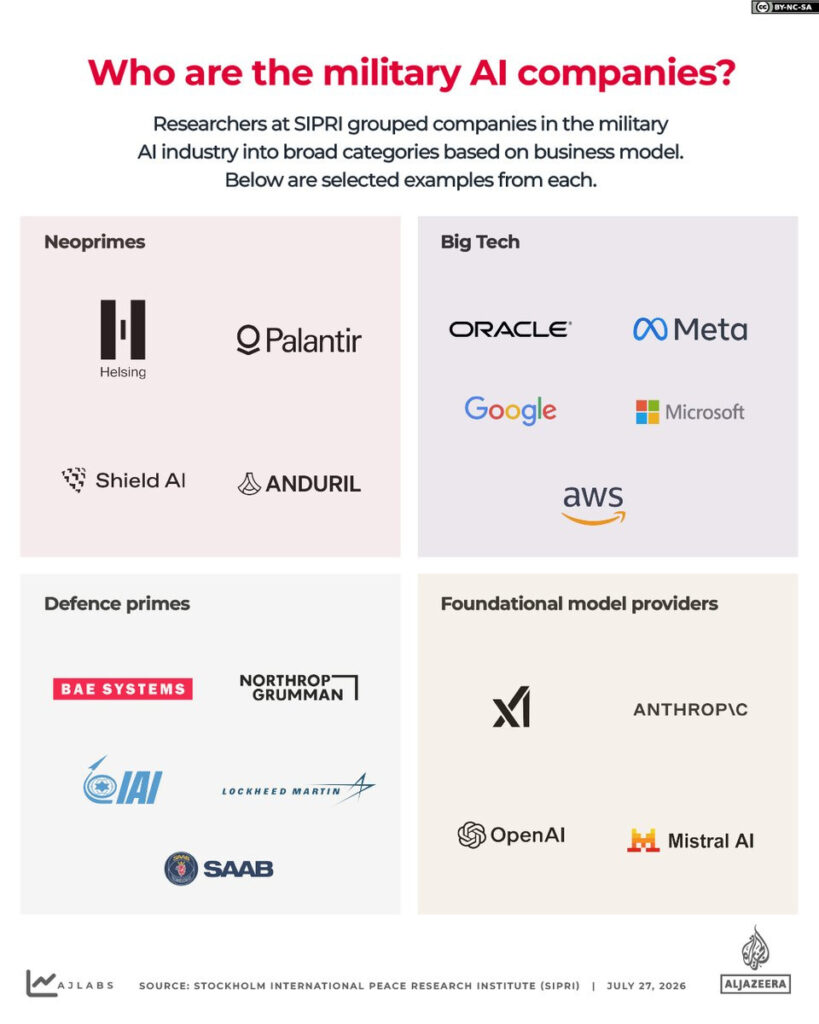
https://www.aljazeera.com/news/2026/7/27/the-ai-military-complex-which-are-the-main-companies-in-it
🇺🇸🌍🇨🇳[Analysis: US and China interest convergence and military presence in MENA]
“The United States’ arms transfers to MENA, far outpacing China’s, remain a key strength of its military engagement with the region. According to the Stockholm International Peace Research Institute, in 2025, the Middle East (not including North Africa) accounted for about 21 percent of global arms imports. Across all of MENA, the United States’ share of arms imports was 64.3 percent in 2025; China had no recorded deliveries that year (see figure 2).
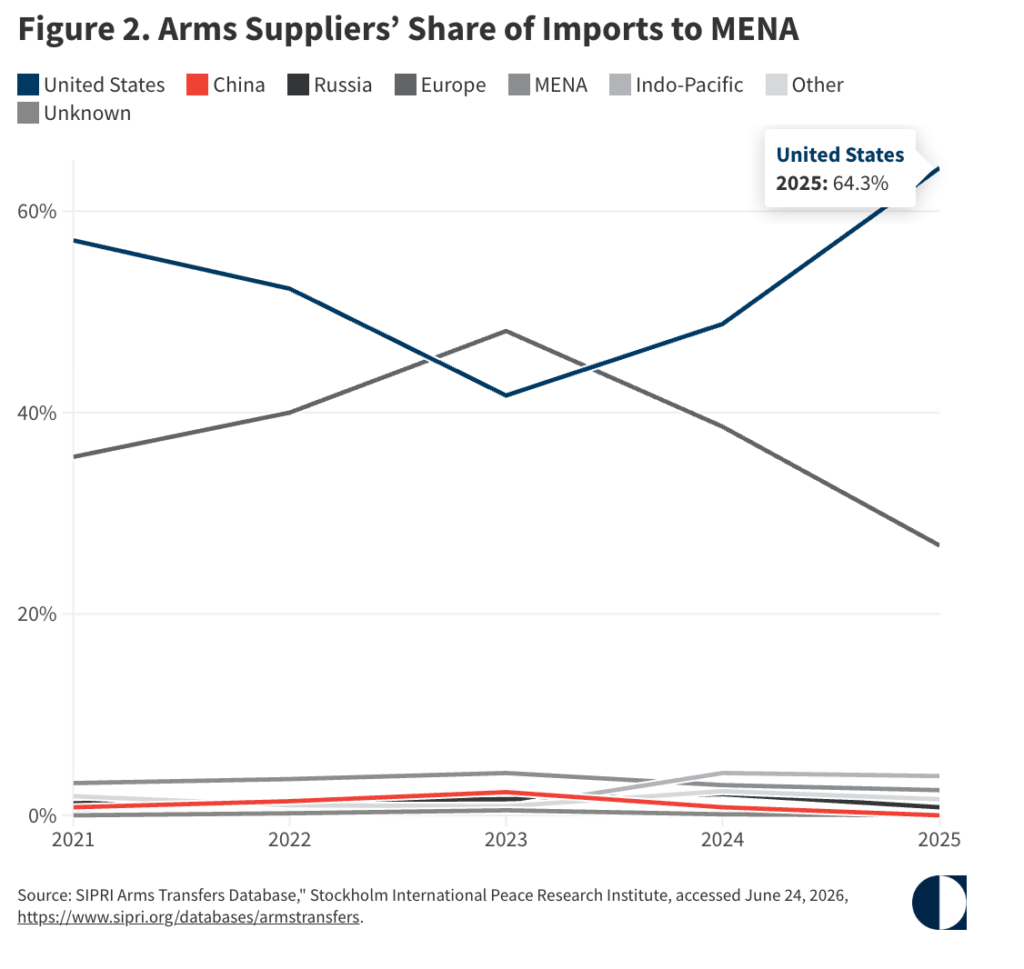
“China’s position of military inferiority is not necessarily a weakness—Beijing benefits greatly from the U.S. security regime in MENA. By not participating in war, and instead adopting anti-war politics, China has gained public favor, remained open to all states in the region, and limited any stains on its legitimacy record. Meanwhile, Washington’s military policies have soiled its record in the region in recent years.
Although China has benefited reputationally from its lack of military presence, it has also faced serious limits to its ability to respond to crises…”
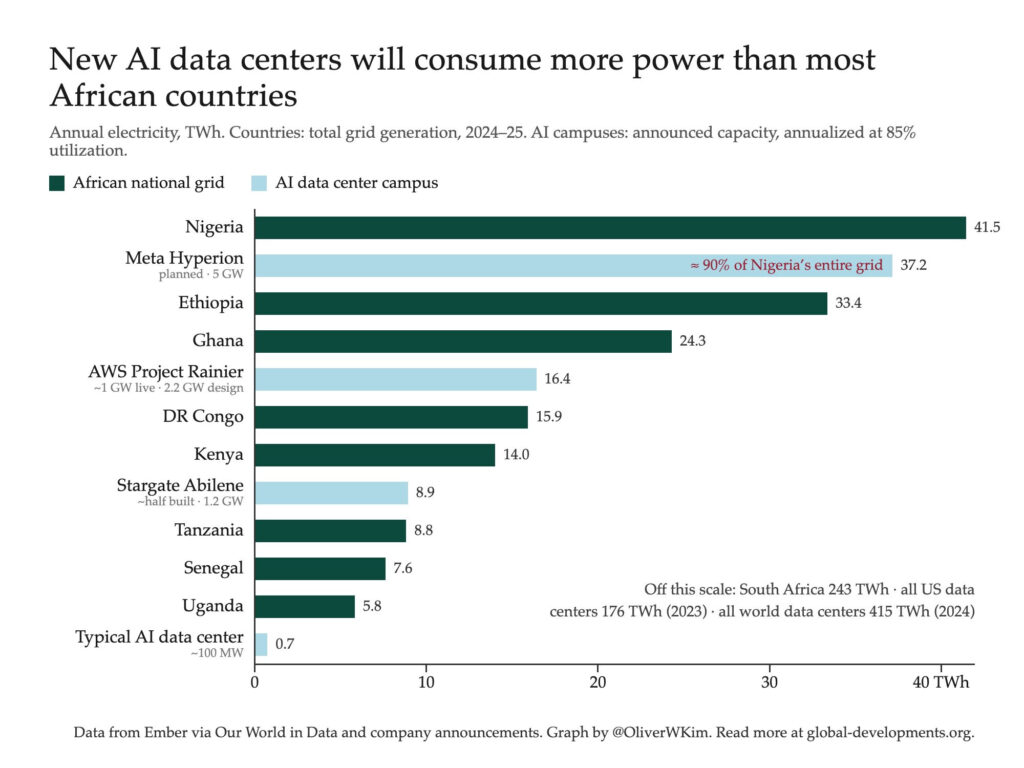
🔋🪫[Datacenters keep growing in size —> and putting pressure on the grid]
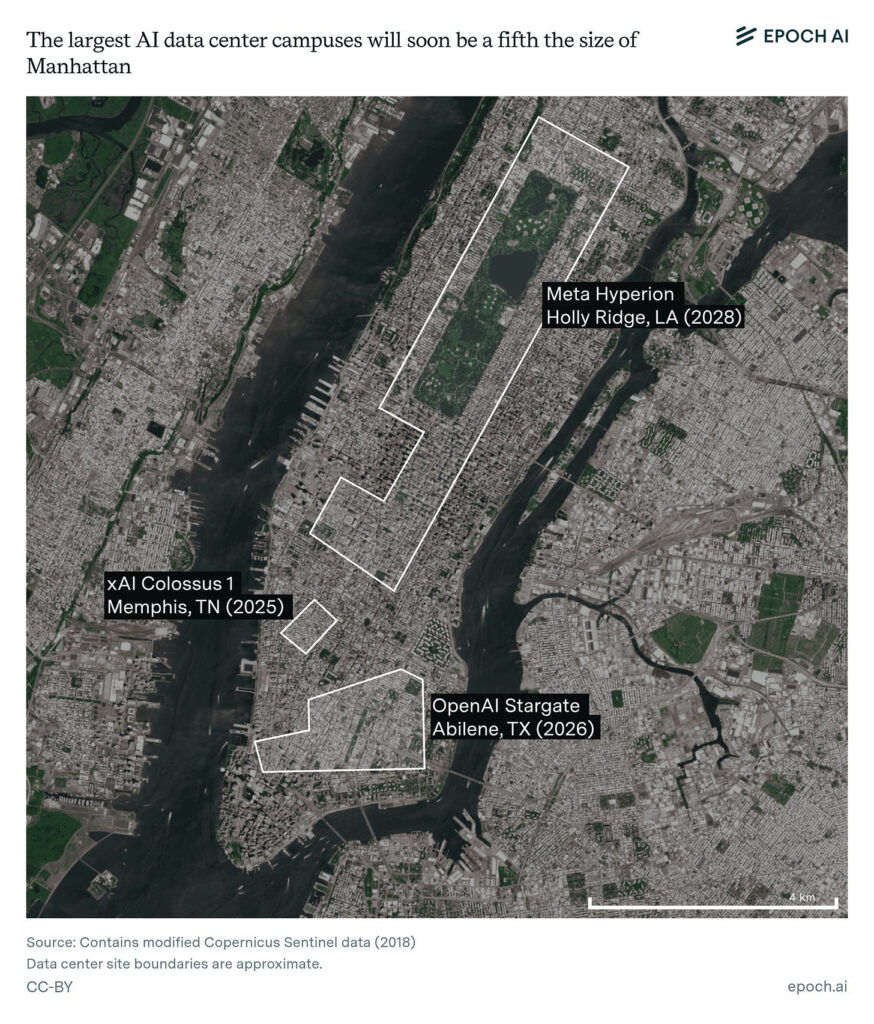
https://epochai.substack.com/p/the-largest-ai-data-center-campuses
See also:
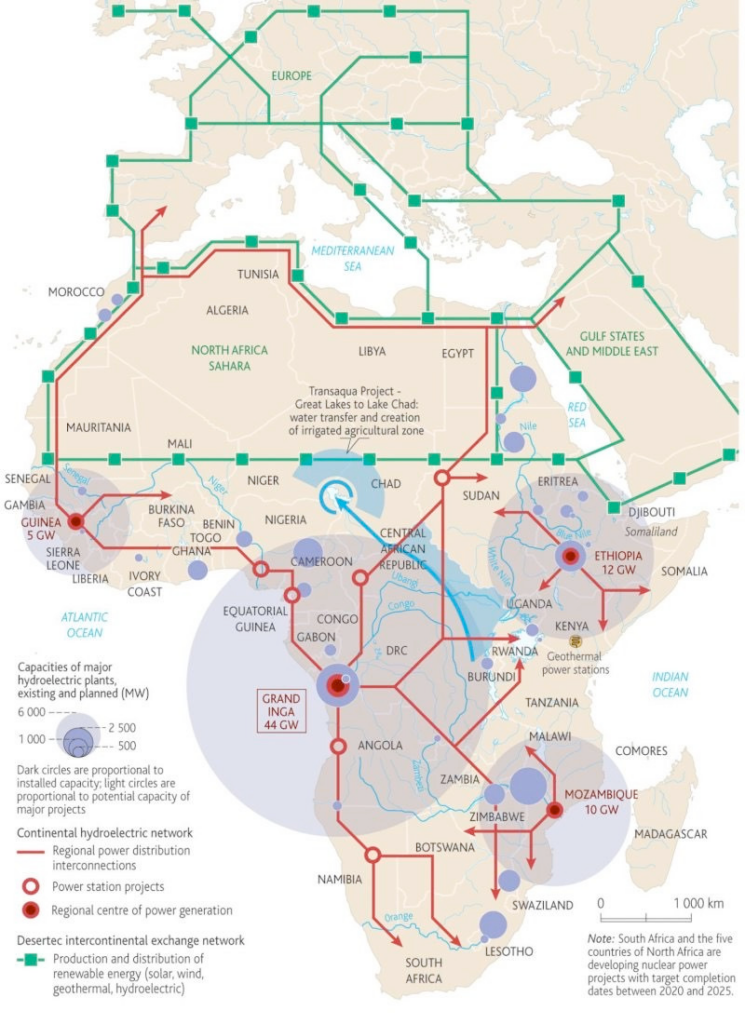
- Deep dive on the evolving African energy grid in NATM Newsletter #26
- Data center maps
🪫 [Opinion: Sovereign AI, independent of America and China, is a pipe dream]
“Aiming for self-sufficiency in hardware is therefore unrealistic. Kevin Xu of Interconnected Capital, an AI- focused hedge fund, argues that sovereignty should be understood less as independence than as control. If the machines being used to run AI models sit within a country’s borders, governments retain a degree of autonomy even if future access to chips is restricted. “Is your factory going to still run if the US government decides that suddenly you can’t?” asks Mr Mensch. The latest AI chips have a lifespan of at least five or six years.
Chips are only part of the equation, however. Running AI places huge demands on the electricity grid. According to the International Energy Agency, an intergovernmental forecaster, a typical AI data centre consumes as much electricity as 100,000 households; the largest may use around 20 times as much.
Countries like Norway, Saudi Arabia and the United Arab Emirates ( UAE) look like attractive places to build data centres because they have abundant, reliable power. The reverse is true in most of Europe, however: grids are congested, there are long waits for connections and electricity prices are high. For many countries, producing enough power for AI will be as difficult as securing enough chips.
Move one layer higher and the picture improves. Most sovereign- AI projects are built on open-source models. These are appealing not simply because they cost less, but also because they offer a higher degree of control…..”
👥 [Opinion: Data Sovereignty Doesn’t Mean Data Isolationism]
“Digital sovereignty can be seen as an extension of the longstanding principle of self-determination. Enshrined in Article 1 of the UN Charter and reaffirmed in the International Covenant on Civil and Political Rights (ICCPR) and the International Covenant on Economic, Social and Cultural Rights (ICESCR), this principle stipulates the peoples’ fundamental right to “pursue their economic, social and cultural development.” Within a digital context, this right acquires a technological dimension: control over data and digital infrastructures becomes integral to the ability to chart an autonomous developmental path.
Informational self-determination was first recognized by the German Constitutional Court in its landmark 1983 Census decision and reaffirmed more recently by the Inter-American Court of Human Rights in the 2023 CAJAR case. It constitutes a standalone fundamental right requiring active state protection.
Traditionally associated with personal data protection, this right must now be interpreted more broadly. Indeed, it seems increasingly evident it has both individual and collective dimensions: individuals should control their personal data, but administrations, corporations and entire societies, too, should be able to exercise control and derive value from the data they generate.”
https://www.techpolicy.press/data-sovereignty-doesnt-mean-data-isolationism
🕸️Research from within the NATM network:
📄🌍🏗️🤖 Journal article by NATM member Vincent Obia, researcher at the University of Sheffield (v.a.obia@sheffield.ac.uk): “The politics of locationality: Interrogating AI development, locational (dis)advantage and governance in Africa”
“The paper considers the question of location in the development and governance of artificial intelligence in Africa. The discussion draws from ideas on locational advantage and the mix of factors that affect inequalities in AI development and how this influences the ability that countries have to shape AI norms, cultures and governance. It analyses policy documents and internet databases to highlight Africa’s place in AI development, the continent’s governance approach and the symbiotic relationship that explains the influence of advanced countries and tech corporations in the AI landscape. Based on this, it proposes the concept of the ‘politics of locationality’ to extend our understanding of how the power resident in AI systems is associated with their primary situatedness and how this reality, in turn, (re)produces imbalances and unequal opportunities for Africa in AI development and governance. It concludes with implications for Africa’s contribution to global AI cultures, design and governance at this time of pressing need for well-balanced AI policies.”
Obia, V. (2025). The politics of locationality: Interrogating AI development, locational (dis)advantage and governance in Africa. Media, Culture & Society, 47(5), 1042-1056.https://journals.sagepub.com/doi/10.1177/01634437251328209
–> Submit contributions to the newsletter

Did a friend forward you this newsletter?
Sign up here to get the NATM newsletter in your inbox!