Curated by Juan Ortiz-Freuler – Sign up to receive as email
🇮🇱🇺🇸//🇮🇷[Israel/US-Iran War expands to datacenters]
🇮🇱🇺🇸📂[US/Israel’s attacks]
“Israel and the US have hit at least two data centers in Tehran, according to Holistic Resilience.
The non-profit, which is mapping airstrikes on Iran, said that one of the data centers was used by the Islamic Revolutionary Guard Corps. Specific information on the facilities and their operators was not shared.
The strikes follow several attacks on Amazon Web Services data centers, with two hit by drone strikes in the UAE and a third damaged in Bahrain. The strikes, which were retaliation for a bombing campaign by the US and Israel, have caused ongoing outages at Amazon’s ME-CENTRAL-1 and ME-SOUTH-1 cloud regions.”
🇮🇷📂[Iran’s attacks:]
“Iran’s semi-official Tasnim News Agency, which is linked to the country’s powerful Islamic Revolutionary Guard Corps, published a list of major U.S. tech companies in a social media post on Tuesday, which included Amazon, Microsoft, Palantir, and Oracle, with the caption: “Enemy’s technological infrastructure: Iran’s new goals in the region.”
Iranian drone strikes have already damaged data centers in the region, hitting Amazon facilities in two countries last week.
The list published by Tasnim was accompanied by a threat that, “with the expansion of regional war dimensions into infrastructure, cyberwarfare, and scope, Iran’s legitimate targets are gradually expanding.”
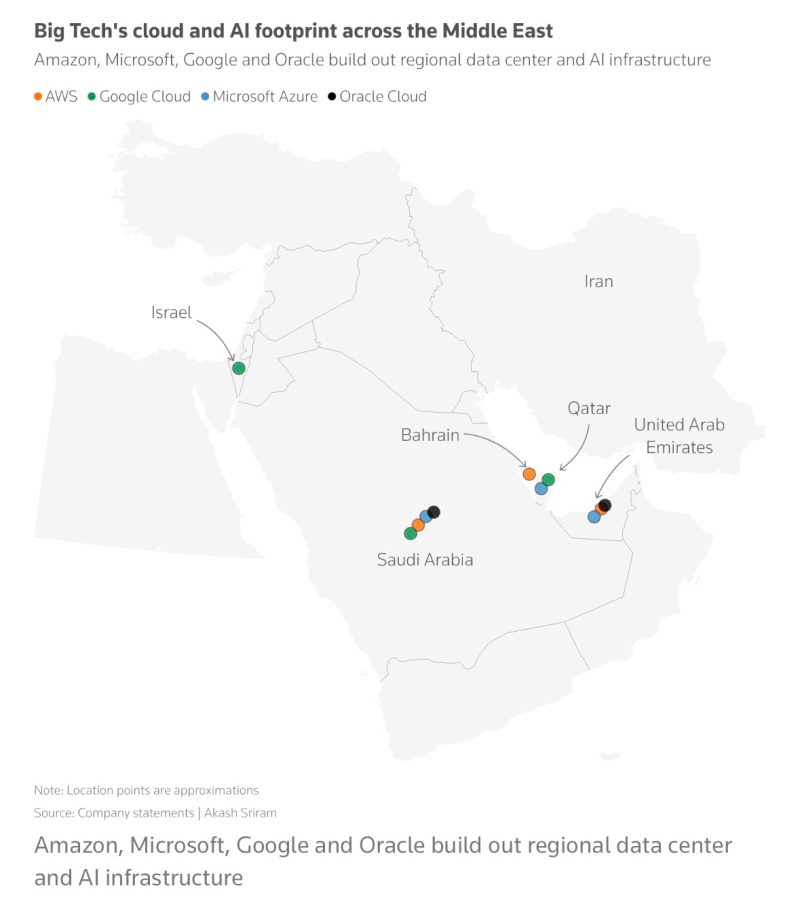
🇮🇷💣📂[Attacks on Gulf datacenters: Analysis]
“The security frameworks behind the U.S.-UAE AI partnership were built for supply chain control and political alignment, not for protecting buildings during a military attack,” Ali Bakir, an assistant professor of international affairs, security, and defense at Qatar University, told Rest of World. “The physical security of strategic digital infrastructure may have been assumed to fall under broader national defense without ever being treated as a distinct vulnerability.”
““Hyperscaler regions are architected around multi-availability zone redundancy,” Gok told Rest of World. “The design assumption is that a single availability zone failure should not cause systemic regional collapse, provided customers have deployed workloads across multiple zones with active failover and tested business continuity plans.”
The Gulf’s cloud infrastructure doesn’t just serve regional clients. Amazon, Microsoft, and Google’s operations in the UAE and Dubai are the digital backbone for fintech platforms across Africa, logistics networks in South Asia, and media and health services in other emerging markets. OpenAI has said its planned UAE campus could eventually serve half the world’s population.”
https://restofworld.org/2026/amazon-uae-data-center-fire-iran-strike
🇺🇸🤖💣 [Claude’s Anthropic War saga]
“Anthropic found itself in a fight over the future of war. For more than a year, Claude has been the AI model of choice for the U.S. government, and the first frontier system cleared for classified use. In January it was used in the audacious capture of Venezuelan President Nicolás Maduro in Caracas. But in the weeks that followed, the relationship between Anthropic and the Pentagon unraveled. On Feb. 27, the Trump Administration announced it would designate the company a supply-chain risk to national security—the first time the U.S. is known to have slapped the label on an American company. The fastest-growing software company in history was now at war with its own government. President Trump ordered the U.S. to cease all use of Anthropic’s software. Pete Hegseth, the Secretary of Defense, announced that any company doing business with the government would be barred from doing business with Anthropic. OpenAI, Anthropic’s rival, swooped in to sign the military contract instead. The most disruptive company in the world had been disrupted.
At the heart of the confrontation is the question of who gets to set limits on a technology that is viewed as one of the most powerful weapons America has at its disposal. Anthropic was happy for its tools to be deployed in war fighting, arguing that bolstering the U.S. military was the only way to avert the threat of authoritarian states like China. But CEO Dario Amodei had objected to the Pentagon’s attempt to renegotiate the company’s government contracts in order to permit “all lawful use.” Amodei cited two specific concerns: he didn’t want Anthropic’s AI to be used in fully autonomous weapons systems, or to conduct mass surveillance of American citizens.“
https://time.com/article/2026/03/11/anthropic-claude-disruptive-company-pentagon
[Anthropic suing over supply-chain risk designation]
“Anthropic is suing the Trump administration, asking federal courts to reverse the Pentagon’s decision designating the artificial intelligence company a “supply chain risk” over its refusal to allow unrestricted military use of its technology.
Anthropic filed two separate lawsuits Monday, one in California federal court and another in the federal appeals court in Washington, D.C., each challenging different aspects of the Pentagon’s actions against the company.“
🇧🇩 🇵🇰 // 🇮🇳 [Analysis: Hormuz reverberations]
Pakistan and Bangladesh might be the first to suffer the Hormuz shock…
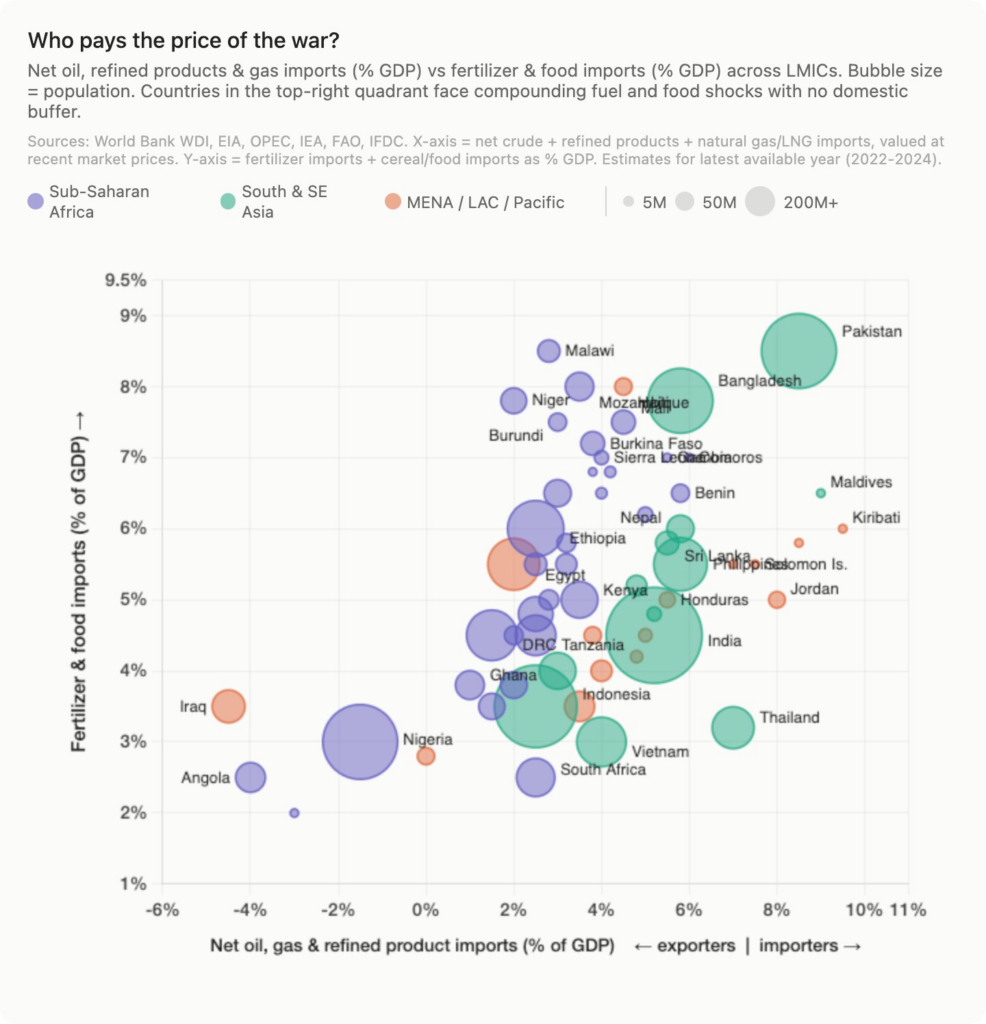
(via Rafael Proença-> @externalidades)
🇮🇳🇺🇸[Analysis: Tech Is the Bright Spot in India-U.S. Relations
“The AI models are American, but the food that feeds the beast is being enriched in India.”
🇮🇳🇺🇸[NEWS: US-India. Deputy Secretary of State Christopher Landau’s gaffe (?) at the Raisina Dialogue]
“India should understand that we are not going to make the same mistakes with India that we made with China 20 years ago in terms of saying, we are going to let you develop all these markets, and then, the next thing we know, you are beating us in a lot of commercial things. “
🇨🇳[China’s Foreign Minister: China “never to seek hegemony”]
“China will never take the beaten path of seeking hegemony as its strength expands, nor does it accept the notion that major powers can dominate global governance, Chinese Foreign Minister Wang Yi said on Sunday.”
🇨🇳[China’s latest 5-year plan]
[Big picture]
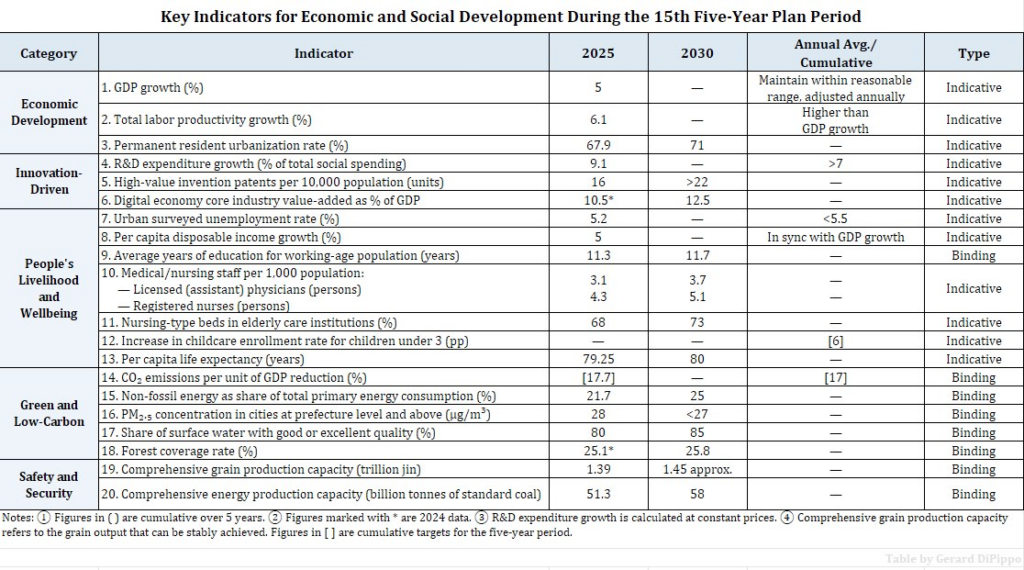
“The outline of the 15th Five-Year Plan (2026-2030) for national economic and social development sets a slew of goals, with high-quality development high on the agenda. Key indicators span areas including economic development, innovation, public well-being, green transition, and security. Many of the indicators focus on people’s livelihoods, sending a clear signal that development is ultimately meant to benefit the people.
Wu Fenggang, a national political advisor, noted that the 15th plan’s wide-ranging indicators will push officials at all levels to move beyond GDP-centric thinking toward more balanced, accountable governance. It is a shift that aligns with the “correct view on governance performance” that became a buzzword at this year’s “two sessions”…”
https://english.www.gov.cn/news/202603/13/content_WS69b36c11c6d00ca5f9a09d96.html
[On tech]
“China doesn’t want to just catch up with the U.S. and Europe in semiconductors and aerospace, but it also wants to lead in those areas along with future industries such as intelligent robotics, biomedicine, quantum technology and what’s known as the “low-altitude” economy, ranging from drones to flying taxis.
Similar ambitions in the past have raised concerns among American and European business groups in China that there will be little opportunity for them.
The Chinese official news agency, Xinhua, tried to allay those fears: “Tech sovereignty is not about isolation,” it said in an editorial.
https://www.npr.org/2026/03/12/nx-s1-5746061/us-china-trade-five-year-plan
🇵🇦 🇺🇸🇨🇳[Panama seizes seizes 2 key canal ports from Hong Kong operator following Supreme Court ruling
“The Panamanian government seized two ports at the entrances of the Panama Canal on Monday according to a Hong Kong-based company that has operated them for decades, a move triggered by a final Supreme Court ruling that declared the company’s concession unconstitutional.
A decree issued Monday authorized the Panama Maritime Authority to occupy the ports for “reasons of urgent social interest,” including all movable property within or outside the Balboa and Cristóbal terminals and specifically naming cranes, vehicles, computer systems and software.”
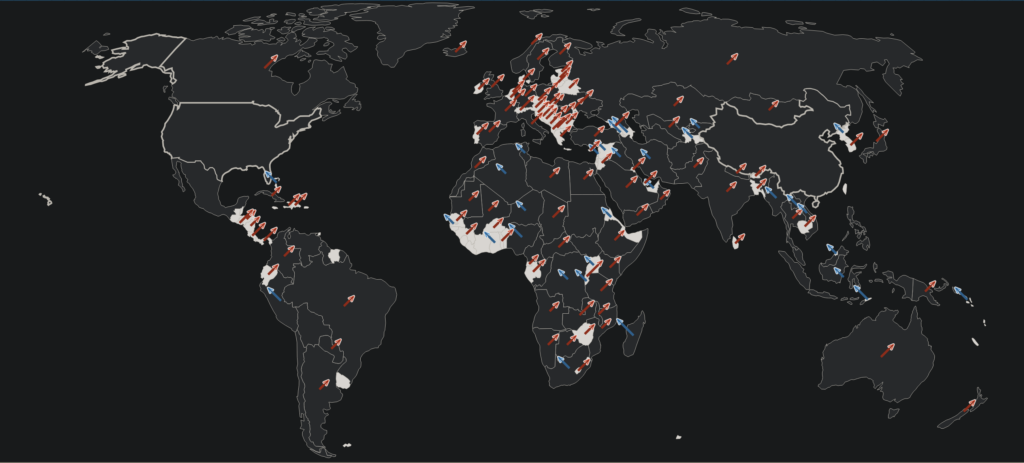
🇺🇸🇨🇳Interactive map: How Trump’s isolationism pushed the world to China
US/China alignment by country, 2024 versus 2025, based on UN voting records
🌎[Transcript of conversation w/ Vijay Prasad: Why the West is an Unreliable Partner for the Global South]
“The turning point for the Global South was the 2008 financial crisis. It became painfully clear then that their growing exports couldn’t rely solely on the sputtering and stagnant European markets. This explains the almost desperate U-turn within BRICS in 2009, when all sorts of initiatives were launched to facilitate, stimulate, and accelerate South-South trade. Since then, we’ve seen, among other things, the Chinese Belt and Road Initiative (better known as the New Silk Roads), the revival of the Shanghai Cooperation Organization, the RCEP free trade area with fifteen countries in the Asia-Pacific region, and so on.”
From within the network:
🗣️[Panel: How can the study of dependency theory enhance digital sovereignty?]
To be held at the Annual Conference of the Society for Social Studies of Science (4S) in Toronto, October 2026! Call for Abstracts (250 words) is open until the end of April. ICo-organized by Guilherme Cavalcante Silva, Juan Ortiz Freuler, Paola Ricaurte, Marco Trigoso, and Raúl Zambrano.
This is the fruit of many discussions within the study group “Dependency Theory and Techno-Imperialism,” which emerged from the Non-Aligned Technology Movement (NATM) network – a coalition of researchers and members of civil society who promote, design, and affirm digital technologies that privilege self-determination, sovereignty, and popular participation.
Feel free to reach out to Guilherme Cavalcante Silva (gcsilva@yorku.ca) for more information!
🇨🇳🇨🇱 🇺🇸[Opinion: US seeks to block first direct cable from South America to Asia]
“On February 20, the US State Department revoked the visas of three Chilean government officials who were in the process of authorizing a $500 million project by a Chinese company, China Mobile, to link Valparaiso and Hong Kong by fiber optic cable.
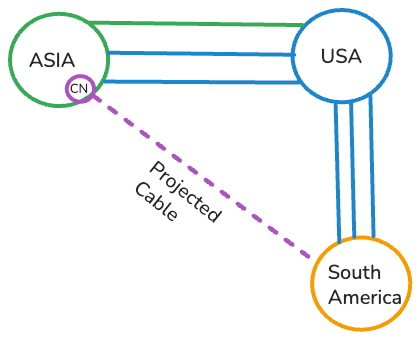
South America is on a tense geopolitical fault line, with a technological stack tightly tethered to the US, while its overall trade relations increasingly reel the region towards China. In such a setting, the region needs to ensure it can engage freely and directly with both powers.
📅[Save the Date: Virtual workshop on infrastructures and platforms, scheduled to take place on May 15]
Organized by the network of researchers on platforms in Argentina, RedInPla. Contact a.l.ferrraribraun@uva.nl for more information
🇪🇺🌎Recording of Webinar: Geopolitical aspects of the EU–Mercosur agreement
Presentation and discussion of the recent study Geopolitical aspects of the EU–Mercosur agreement, commissioned by the European Parliament. The report situates the EU–Mercosur agreement within the broader transformation of the international system, marked by shifting U.S. strategic priorities, the assertive roles of China and Russia, and the relative decline of Europe and Latin America in global power hierarchies. The study not only assesses the prospects for ratification of the agreement but also formulates policy recommendations regarding interregional cooperation, trade, governance, and the energy transition.
Speakers:
- Andrés Malamud (Senior Research Fellow, Institute of Social Sciences, University of Lisbon)
- Luis L. Schenoni (Associate Professor of Political Science, University College London)
Link: https://www.youtube.com/watch?v=_4g4Cf8lvzM
🏰 [Opinion: Digital Governance Stacks and the Infrastructure of Empire]
“A not improbable scenario is that in which highly indebted countries are required to adopt certain technologies that allow the central creditor countries not just to monitor economic performance, policy, and budget expenditure (powers they have, to some extent, accessed over these past years with the internet) but to manage economic policy in real-time, at a distance. This creates new forms of onshoring governance, unleashing the risk that it becomes a path for the emergence of new empires.
(…)
“If big power competition will center on controlling network chokepoints, smaller powers need to develop strategies aimed at neutralizing, splitting, and circumventing those chokepoints. This rationale extends to the design and adoption of digital governance stacks, where the task of identifying such chokepoints has barely begun.”
Link: https://botpopuli.net/digital-governance-stacks-and-the-infrastructure-of-empires/

Sign up here to get the NATM newsletter in your inbox!