Curated by Juan Ortiz Freuler / Sign up / Submit contributions
[NEWS: Commercial satellite imagery in the Middle East]
🇺🇸US commercial providers suspend publication
“Satellite imaging firm Planet Labs said on Saturday it will indefinitely withhold imagery of Iran and the conflict region in the Middle East to comply with a request from the U.S. government. California-based Planet Labs announced the decision in an email to customers, saying the U.S. government had asked all satellite imagery providers to indefinitely withhold imagery of the conflict region”
🇨🇳FT claims Chinese provide targeting services
“Iran secretly acquired a Chinese spy satellite in late 2024 that has allowed it to target U.S. military bases across the Middle East during the current war, the Financial Times reported on Wednesday, an account Beijing dismissed as untrue
The TEE-01B satellite, built and launched by Chinese company Earth Eye Co, was acquired by the Islamic Revolutionary Guard Corps’ Aerospace Force after it was launched into space from China, the report said, citing leaked Iranian military documents.
Iranian military commanders directed the satellite to monitor major U.S. military sites, the newspaper said, citing time-stamped coordinate lists, satellite imagery and orbital analysis. The images were taken in March before and after drone and missile strikes on those locations, the Financial Times said.
As part of the deal, the IRGC received access to commercial ground stations operated by Emposat, a Beijing-based provider of satellite control and data services with a network extending across Asia, Latin America and other regions, according to the report.
The Chinese foreign ministry on Wednesday denied the report, calling it untrue.”
🇮🇱 [Analysis: Mapping of Israeli AI systems and commercial enablers]
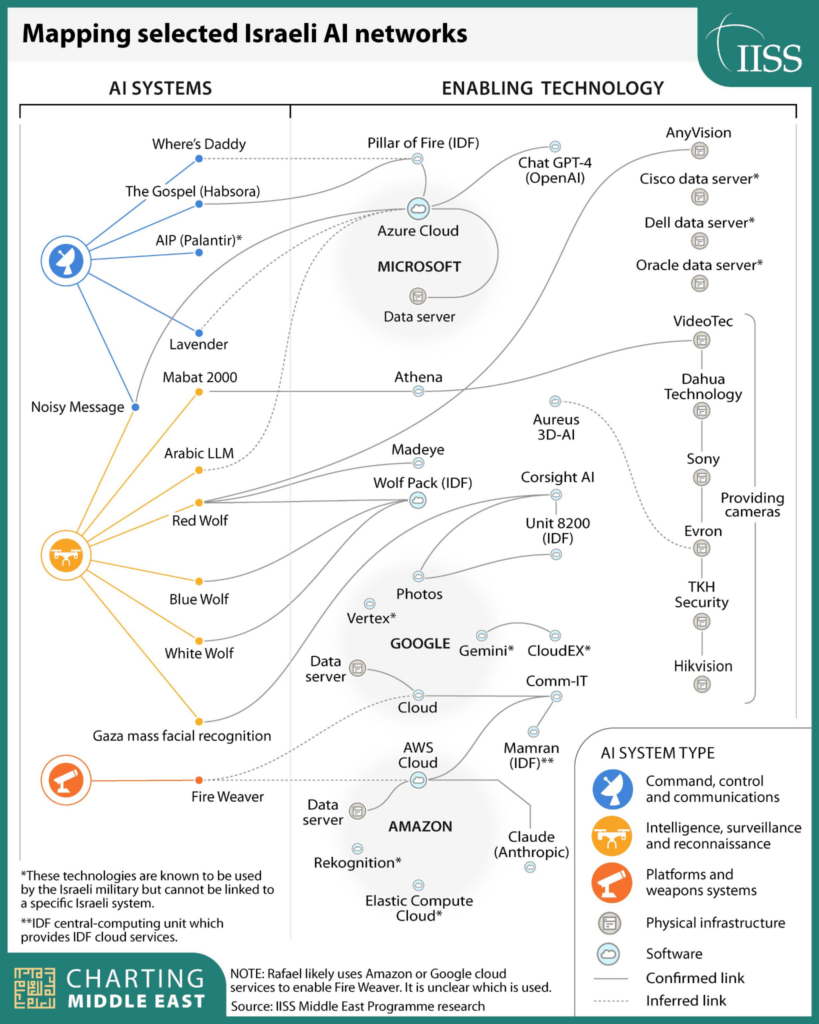
“Big-tech companies such as Amazon, Anthropic, Google, Microsoft, and OpenAI have provided AI products to a variety of defence ministries, including the US and Israel. A 2024 draft contract between Google and the Israeli defence ministry highlighted the latter’s pre-existing exclusive ‘landing zone’ to access cloud infrastructure, and new plans to create specific landing zones for military units.
Under the terms of Project Nimbus, Israel’s state-owned Israel Aerospace Industries and Rafael Defence Industries are required to use the cloud services provided by Amazon and Google for their cloud-computing needs. As Israel stands accused of war crimes, crimes against humanity and genocide at both the International Criminal Court and the International Court of Justice, its deepening cooperation with commercial providers could potentially expose them to liability under both domestic and international-law frameworks. “
🇺🇸🇮🇱🎓🇮🇷[NEWS: US-Israeli operations target dozens of universities in Iran]
“Some 30 universities came under fire in what Iranian academics and students say is an attempt to erase sovereignty and technological autonomy
[…]
Attacks like this suggest the goal is to push Iran backwards scientifically.”
https://www.middleeasteye.net/news/how-iran-universities-became-target-us-israeli-attacks
🇺🇸🇦🇪🔧🇮🇷[Analysis: Iran war complicates US push to export AI to Persian Gulf]
“I would expect the investment there to ramp down slightly, but it does sound like the UAE and Saudi Arabia are still very keen on building out these AI data centers,” said Janet Egan, deputy director of the Center for a New American Security’s Technology and National Security Program. “I don’t think it’s clear that everyone withdraws from the Gulf region.” Widespread destruction in the Middle East over the past month has increased the risks of exporting AI hardware. As my colleague Katherine Long reports, Iranian strikes on AWS data centers in the UAE and Bahrain indicate the facilities may become increasingly attractive targets. A single Blackwell, one of the most advanced chips that Nvidia is selling to build data centers in the region, costs more than $30,000. Data center damage can be extremely costly for U.S. companies and their partners abroad”
🇸🇦[Opinion: Can Saudi Arabia keep hedging?]
“No matter how the conflict ends, however, Saudi Arabia knows it must preserve its economy and its strategic independence. It will continue to look to the United States for some support, but it will have to complement that by deepening its regional alliance with Egypt, Pakistan, and Turkey—and pursuing a greater reliance on China. And it will need to seek a new arrangement with Iran to manage the war’s aftermath. If it can do that and rally the support of all the Gulf Cooperation Council (GCC) states behind its position (including the United Arab Emirates and Bahrain, which have pressed for a more aggressive posture toward Tehran), it stands a chance to grow its regional and global clout after the war is over, not see it dwindle.”
https://www.foreignaffairs.com/middle-east/can-saudi-arabia-keep-hedging
💥[Analysis: Hormuz closure could create Helium shortage-> AI chips hit]
“The closure of the Strait of Hormuz has trapped a third of the world’s commercial helium, threatening the irreplaceable coolant that makes MRI scanners and advanced microchips possible”
Often associated with party balloons, helium is indispensable to magnetic resonance imaging (MRI) scanners, aerospace and the manufacture of microchips for artificial intelligence. With the strait closed, the disruption of the global helium supply chain could have ripple effects that might last for months and affect the most advanced technologies on Earth.
Yet the crisis arrives at a time when the helium market has been awash in surplus, which mitigates the war’s immediate effect. “There is going to be a shortage,” says Phil Kornbluth, founder of Kornbluth Helium Consulting. But the big question, he says, is its duration.”
[…] In chipmaking, fabricators rely on helium most crucially during etching—the selective removal of material to give a chip its features. An advanced AI chip can pack tens of billions of transistors, requiring extreme precision. “You’ve got to image it, define a pattern and then etch out unwanted materials,” says Mike Corbett, managing partner and co-founder of Linx Consulting. “Etch could literally be done hundreds of times per wafer. You have to very accurately control the temperature. I can’t etch one wafer at 100 degrees Celsius and then the next one at 150 degrees Celsius because the etch profile would be different based on the temperature.” To maintain stability, fabs blow helium gas on the backs of wafers to draw heat away. Helium’s exceptional thermal conductivity makes it uniquely effective.”
💥[Analysis: What happens after the AI crash?]
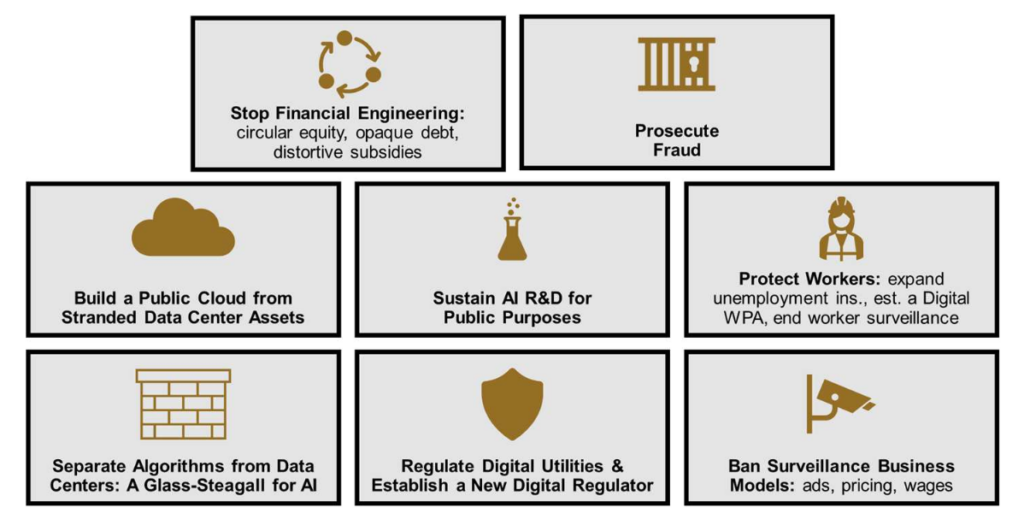
“…this paper describes how a crash might occur and outlines policies for Congress to consider in response. First, Congress could curtail the financial engineering—equity investments, opaque debt, and distortive subsidies—that might become the proximate cause of the crash, and the government should prosecute related fraud. Illegal behavior has been part of many crises, but the government has shied away from prosecuting such crimes recently. Second, Congress should turn data centers that become stranded assets into a public cloud and sustain AI research and development (R&D) for public purposes that companies may stop funding. Congress should also protect workers by expanding unemployment insurance, creating a digital Works Progress Administration, and limiting worker surveillance. Finally, Congress should establish a Glass-Steagall for AI, utility-style regulations for digital utilities, a new regulatory agency, and a ban on extractive business models”
🔺[NEWS: Summit of progressive democratic leaders in Barcelona, Spain]
Lula: “We cannot get up every morning or go to bed every night waiting for a tweet from a president threatening the world.” Without naming Donald Trump, Lula added: “No president of any country in the world, no matter how great, has the right to continue imposing their rules on other countries. None.”
Sanchez: “We all see the attacks against the multilateral system, the repeated attempts to undermine international law and the dangerous normalization of the use of force,” https://apnews.com/article/sanchez-lula-trump-sheinbaum-progressive-summit-e67096a2138f55f3b63d5c24a3b32789
Sanchez: “What we want is to talk and see if we can find a solution to strengthen the democratic process in the world, so that we don’t allow any setbacks…Because when there is a setback, a Hitler happens.” [the event] “will provide the basis for all progressive forces in the world to unite. Our unity will be our strength”. https://www.france24.com/en/europe/20260418-sanchez-lula-rally-left-wing-leaders-in-spain-amid-far-right-surge
🇷🇺🔌🇬🇧[NEWS: Russia probing British undersea cables?]
“Britain accused Russia of using the distraction of events in the Middle East to try to conduct the covert operation in the High North maritime region, home to key shipping routes and critical infrastructure such as undersea cables.
Russia’s embassy in London said Healey’s statement was “impossible to either believe or verify.”
https://www.cbc.ca/news/world/russian-submarines-britain-military-vessels-9.7158613
🇬🇧🔌[Analysis: Britain’s world: The strategy of security in twelve geopolitical maps]
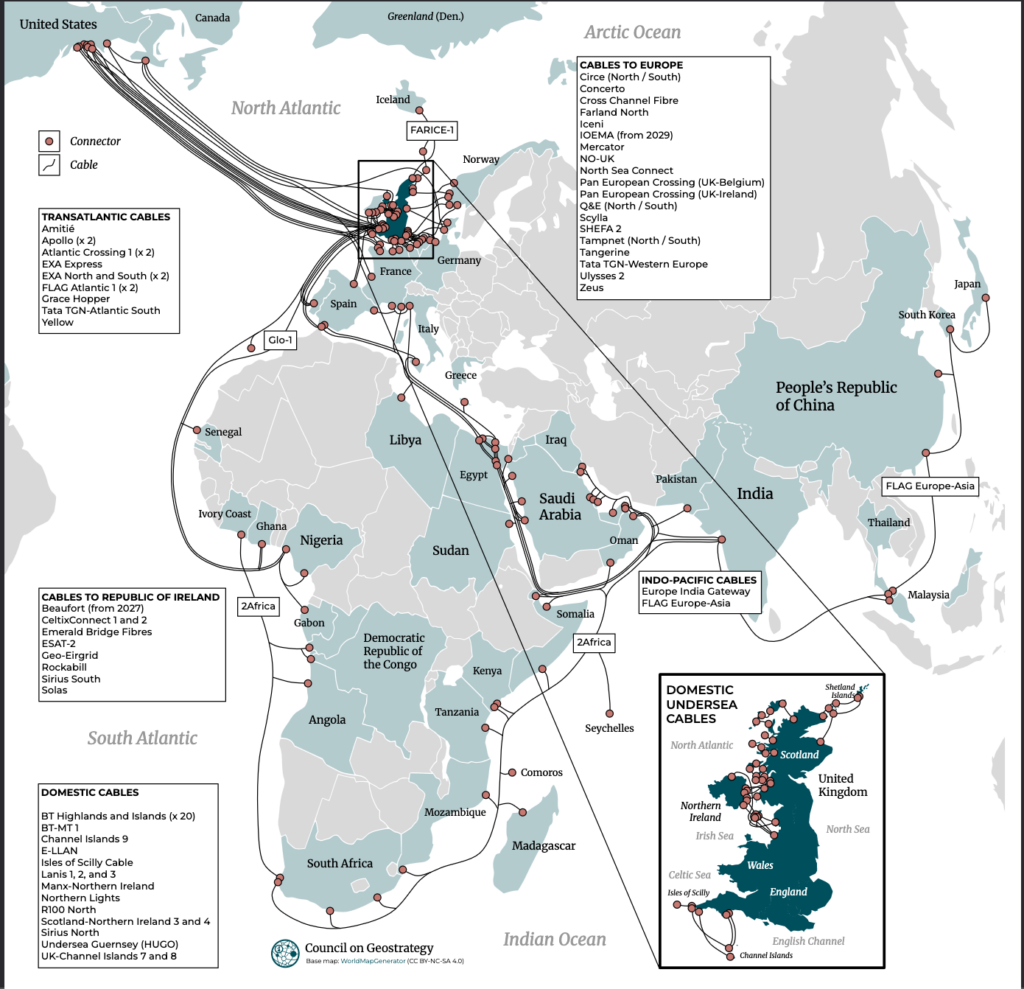
“9% of Britain’s data transmission, accounting for £1.15 trillion in financial transactions, relies on 60 major subsea cables.
Visualization of UK’s reliance on this network of undersea cables->
🔌 🗺️[NEWS: Telegeography releases updated submarine cable map]
Link: https://resources.telegeography.com/2026-submarine-cable-map
🗺️ ♨️ [Analysis: Data centers in areas that are too hot]
“Across the world, countries with hot climates are investing millions of dollars in building data centers to meet the growing demand for generative artificial intelligence while also storing data within their own borders. That’s why data centers are peppered around the world, rather than being concentrated only in cooler countries like Norway or Sweden. Rest of World set out to document how many data centers globally are located in regions that are too hot for optimal operations”
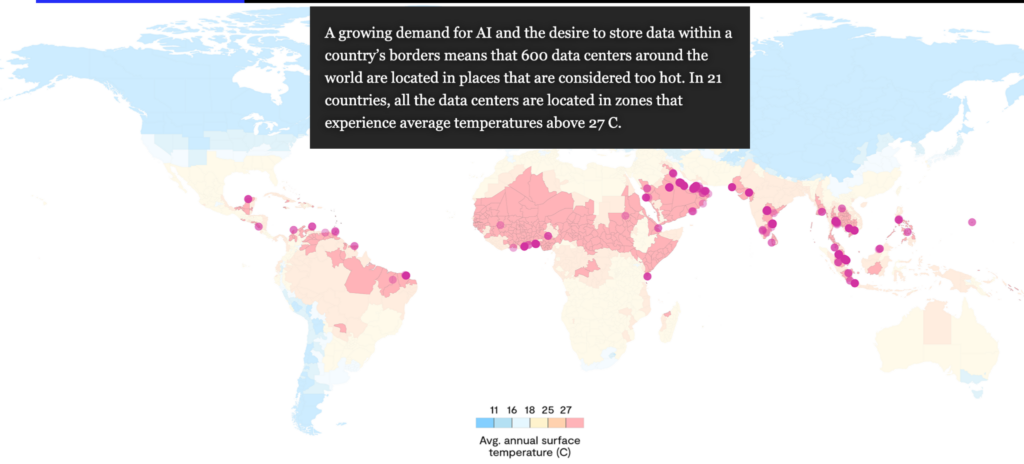
https://restofworld.org/2025/data-center-heat-map
🇮🇩[NEWS: Indonesia commitment to Non-Alignment-> no foreign bases]
“Indonesia is sticking to its principle of not hosting any foreign military base and joining any wars, according to President Prabowo Subianto, as the world witnesses rising tensions.
Prabowo recently had a hand-picked interview with senior journalists and experts…
The ex-defense minister replied that Jakarta would remain committed to its traditional “non-aligned” position of not forging any close alignment with great powers. Indonesia will also give a hard no if any country asks to set up a military base on its soil.” https://jakartaglobe.id/news/indonesia-says-no-to-hosting-foreign-military-base-joining-wars
🇲🇾[NEWS: Malaysia PM claims Non-Alignment pays off commercially]
“Malaysia’s active non-aligned policy makes the country attractive for defence partnerships and investments, says Prime Minister Datuk Seri Anwar Ibrahim.
He said such a policy means that Malaysia maintains working relationships across all major partners.
“A Malaysian supplier enters a supply chain without the political complications that have made sourcing decisions so difficult elsewhere.
“In the current environment, that is a genuine commercial consideration,” he said when launching the Defence Services Asia and National Security Asia 2026 exhibitions.” https://www.thestar.com.my/news/nation/2026/04/21/non-aligned-policy-pays-off
🇮🇳 [Opinion: India’s Autonomy and multi-alignment]
“The grammar of Indian Foreign Policy has gradually changed, especially since 2014. Adoption of strategic autonomy and showcasing an independent policy, based on multi alignment is perhaps a more realistic way to assess the present complexities, congruent to national interests. New Delhi aligns more closely with various countries today in the matters of security, health, energy, education, climate change, reforming the trade system and regulating digital technologies.
The future metrics of foreign policy will, however, deeply hinge on “Digital Statecraft” as well. As economics and geography are also closely linked, the ongoing Ukraine conflict, the Gaza conundrum and now the ongoing Iran conflict in its fourth week add more variations in the overall canvas. Data and the ubiquitous chips are at the centre-stage of this movie. Beyond the oil in the Straits of Hormuz, there’s data and transit of critical minerals and gases which power the manufacturing of world’s most complicated technologies to include semiconductors” https://sundayguardianlive.com/world/foreign-policy-and-digital-statecraft-in-the-time-of-iran-conflict-179898/
🇮🇳 [Opinion: India’s excessive pragmatism comes at a reputational cost]
“The Global South Watches – and Judges. Perhaps the most profound consequence of India’s shifting stance is its impact on its reputation within the Global South. Across Africa, Latin America, and large parts of Asia, support for Palestine remains deeply rooted in shared histories of colonialism and resistance. India, once a leading voice in this moral and political framework, now appears increasingly out of step.
Analysts warn that this divergence risks eroding India’s credibility as a champion of post-colonial solidarity. Its nuanced or hesitant voting patterns at the United Nations, including abstentions on key resolutions concerning Gaza, have further fuelled perceptions of inconsistency.” https://clarionindia.net/india-israel-and-the-crisis-of-strategic-autonomy/
⛿ [Opinion:A New Non-Aligned Movement? Middle Power Moment]
“The “middle powers” can band together to chart a third way between authoritarian superpowers in Washington and Beijing.
Today’s emergent Cold War between the United States and China is also a contest for hearts and minds, but the prize has shifted from the periphery to the middle. A diverse group including both “established” rich countries like Canada, Australia, Japan, and Germany and “emerging” giants like India, Brazil, and Indonesia, the middle powers are the new swing states. The world finds itself in what the Carnegie Endowment’s Stewart Patrick calls a “middle power moment” because the United States has abdicated its traditional managerial role, and China is not yet ready, or perhaps not suited, to step up in Washington’s place. In Carney’s words, the middle powers therefore “must act together,” combining “to create a third path with impact.” The good news is that there are several crucial differences that afford today’s middle powers options that were unavailable to the G-77, that offer reasons to hope they may be more successful than the first version of the NAM in asserting their autonomy.” https://dissentmagazine.org/online_articles/a-new-non-aligned-movement/ via R.Z. and U.M.
⛿⌚ [Opinion: The New Non-Alignment – What’s different? ]
“Three things have fundamentally shifted. First, the Global South is no longer economically marginal. India is the world’s fifth-largest economy. Indonesia is the largest in Southeast Asia. Brazil is simultaneously the world’s largest exporter of several agricultural commodities, a critical minerals giant, and host of COP30. These countries have something great powers want, which gives them leverage the original non-aligned movement never possessed.
Second, the current US-China competition, unlike the Cold War, is as much economic as ideological. Both powers need Global South markets, resources, infrastructure opportunities, and diplomatic votes. Brazil’s economic dependence on China and security cooperation with the United States are both indispensable, making decoupling from either side untenable. That mutual indispensability is not a vulnerability for Brazil. It is the source of its leverage.
Third, Trump’s return to Washington has paradoxically accelerated the trend. When he imposes 50% tariffs on India for buying Russian oil and simultaneously 50% surcharges on Brazilian goods, he does not pull these countries into the Western camp. He pushes them toward each other and toward anyone willing to deal on better terms.” https://moderndiplomacy.eu/2026/04/07/the-new-non-alignment/
💥 [Interview: Non-Alignment & Dependency]
Radio Student from Slovenia-> Min 12:20 -> https://radiostudent.si/druzba/tehno-klistir/tehnolosko-neuvrsceni#

Did a friend forward you this newsletter?Sign up here to get the NATM newsletter in your inbox!