Curated by Juan Ortiz Freuler /Sign up / Submit contributions
🇺🇸🇨🇳[NEWS: Xi-Trump summit readout]
“China will open wider” (Xinhua/CNBC)
“Xi said that U.S. companies are deeply involved in China’s reform and opening up, and both sides have benefited from this,” according to a report from state-backed newspaper Xinhua.
“Noting that China’s door will only open wider, Xi said China welcomes the United States to enhance mutually beneficial cooperation with China, and expressed belief that U.S. companies will enjoy even broader prospects in China.”
Bessent told CNBC that China and the U.S. are going to work together on a safety protocol on “best practices for AI to make sure nonstate actors don’t get a hold of these models.”
https://www.cnbc.com/2026/05/14/xi-china-open-us-business-ai-chips.html
No major agreements on tech (Time magazine):
“Several observers had also hoped that the talks would produce a broader framework on A.I. governance or U.S.-China technological cooperation.
But the talks looked more “like a trade show” especially from the U.S. side, says Chong Ja Ian, a professor of international relations at the National University of Singapore. Any deals to come out of it are expected to focus on the “three Bs”—Boeing, beef, and beans—which the U.S. wants China to purchase more of. U.S. Trade Representative Jamieson Greer told Bloomberg on Friday that U.S. export controls on semiconductor chips were not a major part of the talks.” https://time.com/article/2026/05/15/trump-xi-us-china-summit-ai-semiconductor-chips/
A new international order
“For decades, the post-Cold War international system operated on the assumption of Western permanence. The United States projected military, financial, and institutional dominance globally, while Europe sought to present itself as the moral and normative centre of international governance. Yet the geopolitical landscape of 2026 reveals a very different reality: a fragmented world, fatigued by conflict, increasingly skeptical of ideological universalism, and deeply distrustful of selective interpretations of international law and global norms.
This is precisely why the Xi–Trump encounter will be closely watched across Africa, Latin America, the Middle East, and large parts of Asia. For much of the Global South, the central question is no longer whether the United States remains powerful, but whether Washington still offers a convincing vision of international leadership.
The repeated articulation of the concept of “peace through strength” by the United States has significantly contributed to this erosion of credibility. While such language may resonate domestically within strategic and military circles, it generates profound discomfort across many developing nations. The underlying perception is that excessive reliance on coercion, sanctions, military pressure, and strategic intimidation ultimately weakens the legitimacy of the international system.
From the perspective of much of the Global South, stability cannot arise solely from military superiority. Development, infrastructure, technological access, poverty reduction, and economic inclusion are seen as far more sustainable foundations for peace than the permanent threat of force. Countries that have experienced colonialism, interventionism, or externally imposed political models tend to be particularly resistant to doctrines that appear to normalize the use of power as the principal organizing mechanism of international relations.
This does not necessarily imply unconditional alignment with China. Rather, it reflects the growing appeal of a discourse centered on sovereignty, development, and pragmatic coexistence. Beijing has perhaps understood more clearly than many Western capitals….”
https://www.policycenter.ma/publications/beijing-washington-and-global-south
Taiwan question gains centrality / North Korea risk loses spotlight:
“Safeguarding peace and stability across the Taiwan Strait is the biggest common denominator between China and the U.S.,” Xi was quoted as saying in the readout posted by the Chinese Foreign Ministry. If the issue of Taiwan is handled improperly, “the two countries will have clashes and even conflicts, putting the entire relationship in great jeopardy,” according to Xi.
Trump did not publicly respond to questions on Taiwan after the summit, and the White House made no mention of the subject in its statements.
According to Chinese state media, the two leaders also discussed the Middle East, Ukraine, and the Korean Peninsula, though no details of those discussions were reported.
For South Korea, the summit between Trump and Xi changed little but it clarified the pressures Seoul now faces.”
https://thediplomat.com/2026/05/trump-xi-summit-leaves-south-korea-navigating-familiar-pressures
What kind of US does China want?
“For years, Beijing seemed content with a relatively stable, gradually declining America—one challenging enough to sharpen Chinese ambition, predictable enough to plan around—as China steadily narrowed the gap in power and influence. A more volatile and internally divided America, less committed to alliances and more erratic in its foreign policies, does not necessarily serve China’s interests. America may appear weaker in certain respects, it is also less predictable and more prone to military miscalculation. For Chinese policymakers, managing a competitor that is both strategically powerful and politically unstable may prove more difficult than dealing with one that is consistent, if adversarial.
Against this backdrop, Beijing has come to treat strategic competition with Washington as a protracted condition rather than a passing phase.”
https://time.com/article/2026/05/13/china-first-trump-xi-beijing-summit
Changes in Global South strategy
“The danger now is that development becomes over-securitised. If every port is seen as a military asset, every digital platform as a surveillance risk, every mineral corridor as a strategic battlefield and every infrastructure loan as a geopolitical signal, then lower-income countries lose room to negotiate around their own priorities. Rivalry may bring more attention and sometimes more money, but it can also fragment standards, raise borrowing costs, politicise technology choices and reduce trust.”
[…]
This is also where contemporary South-South cooperation is changing. It is no longer only about political solidarity or alternative sources of finance. It is increasingly about how countries, firms and institutions bargain within a fragmented, multiplex order. Power is not organised around one centre, or even two. It is dispersed across development banks, regional platforms, firms, digital systems, supply chains, philanthropic capital, sovereign funds and middle-power coalitions.
The Trump–Xi summit tells us that US–China relations will remain unstable, even when carefully managed. For the global South, the task is not to wait for a new settlement between Washington and Beijing. It is to use this unsettled moment to expand policy space, strengthen bargaining power and build coalitions that are not reducible to great-power competition.
The future of development will not be decided only in Beijing or Washington. It will also be shaped in Addis Ababa, Brasília, Delhi, Jakarta, Johannesburg, Riyadh, Brussels and London, wherever governments, institutions, firms and societies are asking a more practical question: how can countries protect development choices and policy space in a world where cooperation and rivalry now travel together?” https://www.ids.ac.uk/opinions/what-the-trump-xi-summit-tells-us-about-the-new-politics-of-global-development/
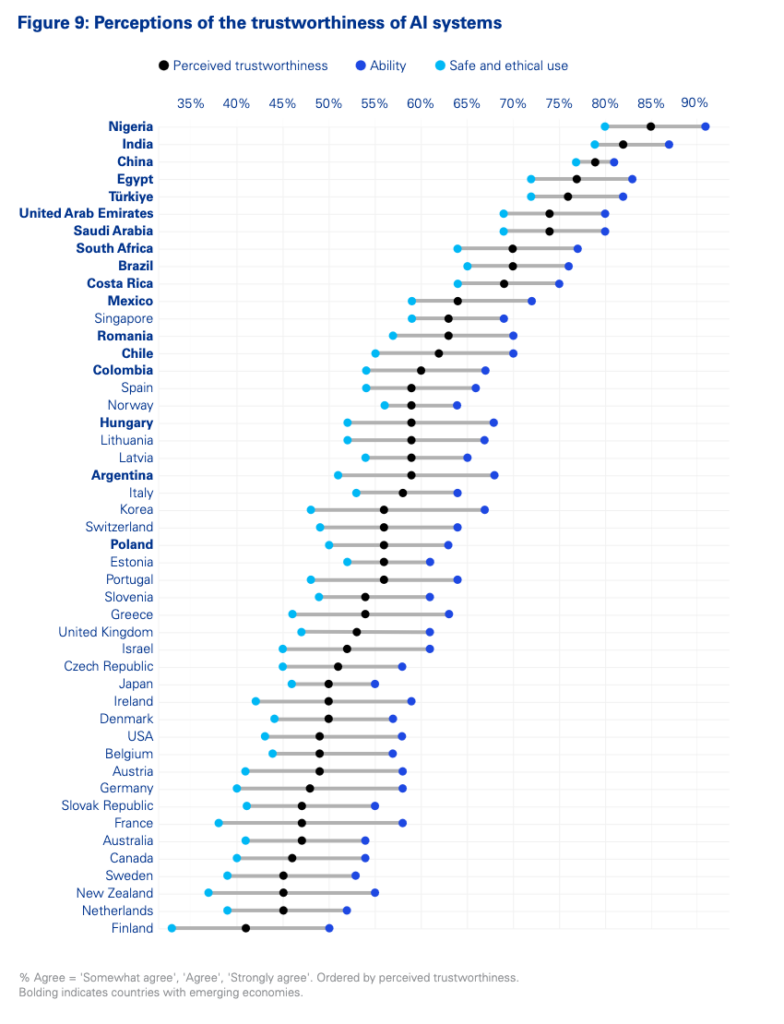
🇪🇺 🇨🇳🇺🇸[Survey: The trust gap between US/EU and Asia when it comes to AI]
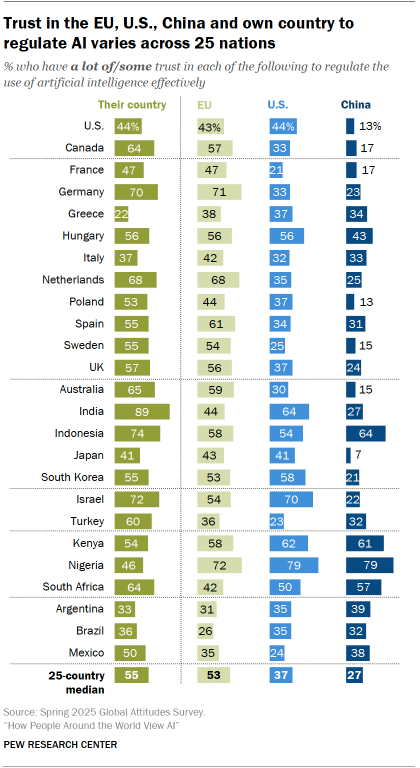
🇪🇺 🇨🇳🇺🇸 [Survey: Trust in the ability of major powers to regulate AI]
🇺🇸🎓🤖[NEWS: Eric Schmidt’s Ai-optimism commencement speech booed in Arizona(Video)]
🇺🇸[NEWS: White House accuses Chinese AI companies of industrial scale distilling of US AI]
“…the United States government has information indicating that foreign entities, principally based in China, are engaged in deliberate, industrial-scale campaigns to distill U.S. frontier AI systems. Leveraging tens of thousands of proxy accounts to evade detection and using jailbreaking techniques to expose proprietary information, these coordinated campaigns systematically extract capabilities from American AI models, exploiting American expertise and innovation. Models developed from surreptitious, unauthorized distillation campaigns like this do not replicate the full performance of the original. They do, however, enable foreign actors to release products that appear to perform comparably on select benchmarks at a fraction of the cost. These distillation campaigns also allow those actors to deliberately strip security protocols from the resulting models and undo mechanisms that ensure those AI models are ideologically neutral and truth-seeking.”
https://whitehouse.gov/wp-content/uploads/2026/04/NSTM-4.pdf
🇺🇸🚀[NEWS: US Space Force publishes foresight report]
Perspectives on Non-Alignment:
“Over the next 15 years, the non-aligned states will further intensify the complexity of an evolving heteropolar order, with a growing number of capable actors that do not consistently align with any single major power. These non-aligned actors may form flexible regional blocs, establish technical standards, and contribute to shaping norms. In such an environment, gaps in engagement could leave the United States with reduced support in norm-setting venues and standards bodies, complicating efforts to sustain predictable commercial freedom of action and interoperable space services. Non-aligned participants, like India or Brazil, are likely to field mixed civil-military portfolios that include expanded STM, proliferated communications and sensing constellations, and regulatory frameworks that accelerate commercial participation. Some could develop responsive launch ecosystems, pursue prominent broadband constellations, and explore on-orbit servicing, refueling, and space weather monitoring”
https://www.spaceforce.mil/Portals/2/Documents/SAF_2026/Future_Operating_Environment_2040_Final.pdf
📣[News from within the network]
Fill in the form to add your news to the next newsletter!:
New publication by NATM subscriber, Christopher W. Chagnon, University of Helsinki, (christopher.chagnon@helsinki.fi)
⛏️ “Digital extractivism(s) and digitally-facilitated extractivism(s)” open access in Human Geography, defining the concept of digital extractivisms and reviewing the state of research
New publications by NATM co-initiator, Juan Ortiz-Freuler (juanof@protonmail.com):
🔎 Ortiz-Freuler, J., & Castells, M. (2026). From search engines to AI agents: Interface control and the restructuring of communication power. Open access in New Media & Society, discussing the evolution of these interfaces and conceptualising how corporations and states tussle over interface design and the powers it affords.
📡Ortiz-Freuler, J. (2026). Neutralising the propaganda machine: proposals for cyber-propaganda de-escalation. Journal of Cyber Policy, 1-19. [open access copy here]. A re-framing of cyber-propaganda as a shared global challenge and a taxonomy that distinguishes between infrastructural and operational components of disarmament and de-escalation processes to tackle it.
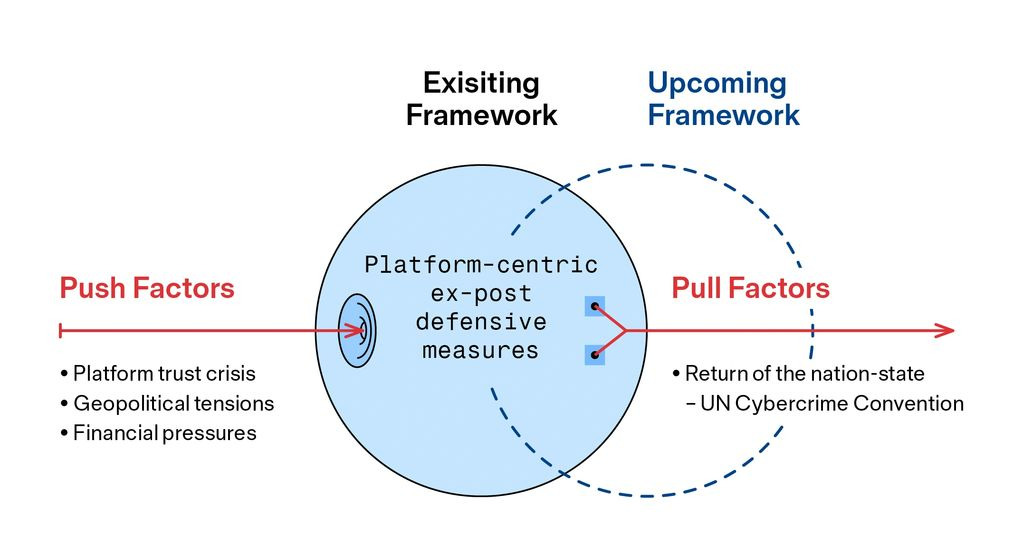
Submit contributions for next month’s newsletter!
OPINION
🧑🏽🏭[Opinion: Big Tech’s Cross-Border Abuses Demand an International Response]
“…Historically, labor movements, postcolonial states, and regional formations repeatedly attempted to increase their bargaining power through collective negotiation, coordinated standards, and South-South solidarity, including through moments such as the Bandung Conference and the broader Non-Aligned Movement. Yet such efforts were frequently weakened by colonial and postcolonial economic hierarchies, debt dependency, external intervention, and the strategic interests of Global North powers seeking access to labor, markets, and natural resources in the Global South.
But today there may be new possibilities for strategic alignment between states across both the Global North and Global South. Governments are confronting many of the same tech firms over questions of taxation, labor protections, electoral manipulation, platform accountability, misinformation, data governance, and digital sovereignty. The growing tensions between European regulators and major American technology firms, alongside legal actions and public controversies emerging within the United States itself over AI harms, suggest that dissatisfaction with the growing power of these corporations is no longer confined to any single region or political bloc.”
https://jacobin.com/2026/05/big-tech-capital-international-response
⏩[Opinion: Digital Bandung]
“Digital counter-colonization would require many of the same things that actors in the Global South were asking for in the 1960s and 1970s: matching the promise of national sovereignty formally held out by international law with the capacity to exercise that sovereignty. Alongside digital empires, one could discuss a Digital Non-Aligned Movement and a Silicon Bandung to create space between the two poles of absolute refusal and absolute domination. Brazil’s legal pushback against the non-compliance of Musk’s X and recent push toward data localization and domestic data center construction under the banner of “digital sovereignty” represent efforts in this direction.
There are two reasons the critical literature scarcely calls for digital nationalism. The first is that the most potent efforts to contain the World Wide Web within national borders have come from authoritarian countries seeking to stifle the free exchange of ideas and any challenge to one-party rule. In the most prominent example, the so-called Great Firewall has inoculated Chinese society against external political interference while fostering replacements for Silicon Valley’s products in national champions like Baidu, WeChat, and Alibaba. With the exception of high-end AI chips, China has built the full stack of hardware, software, and apps to enhance its own national capacity against the incursions of would-be “digital empires”—but its own curtailment of political freedoms makes it a dim beacon for most progressive scholars and activists.
Another reason digital nationalism feels inadequate to many critics is that they are writing from a theoretical tradition in which the achievement of formal independence was a false dawn. For instance, the Peruvian sociologist Aníbal Quijano’s influential concept of the “coloniality of power” claims that in important ways colonialism never ended. The racialized hierarchies that were essential to the colonizing project persisted into the era of national independence. In this understanding, the very structure of Western rationality has always worked to discredit and extinguish indigenous forms of knowledge; digital technologies and platforms are merely the most recent carriers of the pathogen of modernity.” https://www.theideasletter.org/essay/digital-bandung/
🇮🇳[Opinion: India’s multi-alignment]
“India’s push for a more democratized and multipolar global order was a byproduct of its strategy of multialignment, as only in a multipolar world could multialignment be truly safeguarded. Consequently, India pushed for greater representation in the United Nations and Western-led international financial Institutions (IFIs) such as the International Monetary Fund and the World Bank.
Rooted primarily in self-interest more than idealism, especially in recent decades, India’s multialignment strategy does not preclude tilts toward a particular major power under contingencies. But when the utility of such tilts has run its course, India has often corrected them, though sometimes with a significant time lag.”
[…]
The 2026 U.S.-Israel war against Iran also indicates that India overplayed its Israel hand.25 In the coming months, Iran may emerge stronger than Gulf Cooperation Council states as the gatekeeper of vital energy supplies through the Strait of Hormuz and the U.S. role in the region could weaken.26 In such a scenario, India’s tilt toward Israel will turn out to be a net negative for its core interests.
Those developments indicate that, sooner or later, India will likely go through another correction in its strategic orientation. In fact, one could already be incipient, with the prioritization of the Global South in New Delhi’s foreign policy rhetoric and an emerging (though limited) thaw with China.”
https://www.cfr.org/articles/indias-multialignment-and-democratization-of-the-international-order
Sign-up/Unsubscribe:
Did a friend forward you this newsletter? Sign up hereto get the NATM newsletter in your inbox!
🎤 Send your contributions for the next newsletter through this form