Curated by Juan Ortiz-Freuler / Sign up / Submit contributions / Sept 2026
🎂 [NEWS: 65 Anniversary of the Non-Aligned Movement]
Fragment of 1961 Belgrade Declaration:
“noting that there are crises that lead towards a world conflict in the transition from an old order based on domination to a new order based on co-operation between nations, founded on freedom, equality and social justice for the promotion of prosperity; considering that the dynamic processes and forms of social change often result in or represent a conflict between the old established and the new emerging nationalist forces; considering that a lasting peace can be achieved only if this confrontation leads to a world where the domination of colonialism-imperialist and neo-colonialism in all their manifestations is radically eliminated; And recognizing the fact that acute emergencies threatening world peace now exist in this period of conflict in Africa, Asia, Europe and Latin America and big power rivalry likely to result in world conflagration cannot be excluded; that to eradicate basically the source of conflict is to eradicate colonialism in all its manifestations and to accept and practice a policy of peaceful coexistence in this world.
That guided by these principles the period of transition and conflict can lay a firm foundation of cooperation and brotherhood between nations…”
http://cns.miis.edu/nam/documents/Official_Document/1st_Summit_FD_Belgrade_Declaration_1961.pdf

Today:
“Six and a half decades later, the Movement is again emphasizing multilateralism, international law, sovereign equality and cooperation — principles that remain central to debates over Africa’s place in a rapidly changing global order.
The meeting opened with addresses by Serbian President Aleksandar Vučić, and Ugandan Vice President Jessica Alupo, who spoke on behalf of Ugandan President Yoweri Museveni, as Uganda currently chairs NAM.
Vučić described NAM as an important pillar of multilateralism and warned against what he described as selective approaches to international law.”
https://pulseofafrica.info/news/4801
🌎🇺🇸[NEWS: State Department outlines expansive interpretation of Monroe Doctrine with US framed as empire in video]
Sec. of State spokesperson: “…what began as a warning to European powers evolved into a framework for regional dominance. One that remains the cornerstone of American strategy in the region today..”
🇺🇸🇦🇷🇨🇳[NEWS: China rebukes US over Huawei dispute as Argentina’s Milei balances ties with Washington and Beijing]
“China and the United States are clashing diplomatically in Argentina as President Javier Milei seeks to preserve his close alliance with Washington while pursuing deeper economic ties with Beijing.
China’s embassy in Buenos Aires accused the United States of hypocrisy on Thursday after an electricity cooperative in Argentina’s Neuquen province said the U.S. Embassy threatened to revoke its executives’ visas over an agreement with Chinese telecommunications giant Huawei.” “These actions fully reflect the arrogance and prejudice of the United States. They constitute a serious lack of respect for the sovereignty of other countries and a serious infringement of the principles of the free market,” the embassy said in a statement.
See also: https://chinaglobalsouth.com/2026/08/17/us-china-rivalry-argentina-chile-visa-pressure/
🇺🇸✂️🇨🇺[NEWS: Automated US sanction machine blocks Cuban sandwich shop in Belfast?]
“Carlos Arguelles Leblanch, who owns the Cuban Sandwich Factory, said he believed banking software mistakenly identified his business as one which should be subject to recently stepped-up US sanctions.
Many of his customers come through the delivery app Deliveroo. In his case, when an order is placed, payment first goes through Citibank before reaching him, and this, he claimed, is where the issues occurred. Citibank said: “The matter required a necessary compliance review, which has now been completed, and the payments have been released.”
https://www.bbc.com/news/articles/cd79e5xqr2xo
🇺🇸🇨🇳[NEWS: US tells partners to choose side in AI race with China]
“The U.S. is preparing to tell dozens of countries they must pick sides in the artificial intelligence race with China, warning they will be excluded from a U.S.-led AI coalition if they also sign up for Beijing’s competing framework”
🇺🇸🇨🇳[ANALYSIS: An attempt to sketch the current divide]

📣🇺🇾[News: Panamerican Congress Declaration of Montevideo]
Released declaration includes a call to
“Govern the technologies controlled today by a handful of corporations, affirming the principle of digital sovereignty to protect the privacy of our citizens and the development of our economies, and rejecting the reproduction, in digital form, of resource extraction carried out to enrich servers and shareholders abroad;’
https://panamericancongress.org/panam_mdeo_declaration_en
🇧🇷⛏️ 🇦🇺 🇺🇸[NEWS: US, Australia and others turning to Brazil for rare earth minerals]
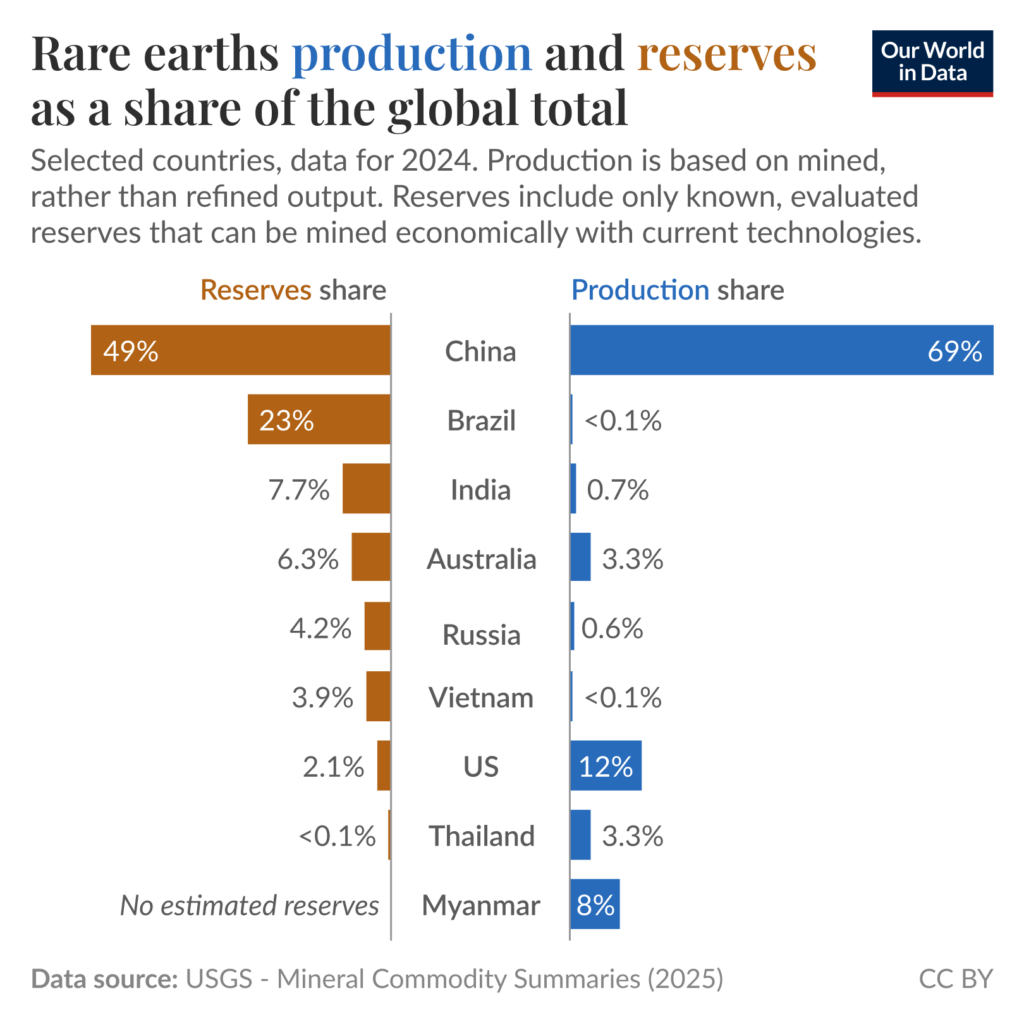
“The world is increasingly turning to Brazil to explore for rare earth minerals that are crucial for technology and renewable energy. The country’s large reserves are second only to China and have attracted investors, many of them with foreign support.
An analysis by The Associated Press and Reporter Brasil of all National Mining Agency records through June shows that rare earth exploration applications have surged, with more than 86% filed in the past three years, including 268 in the first half of 2026. The interest is already raising environmental concerns for the Amazon and other areas.”
🇺🇸🌍 🇨🇳[NEWS: US companies win billions in African data center deals in direct competition with China]
“The U.S. is beating China in a high-tech trade war over data centers in a fierce battle being waged across Africa.
Major new deals have been engineered in a public-private partnership between the Trump administration and U.S. companies in Africa, while States across the U.S. clamp down on the centers over their massive reliance on electricity. The administration’s Bureau of African Affairs has reported it has worked on 37 commercial transactions that have closed since the beginning of President Donald Trump’s second term — representing $25.67 billion in total value, with more still being reported.”
🇪🇬🇺🇸🇨🇳[NEWS: As the China-US AI race reaches Cairo, Egypt faces a strategic decision]
“Xi’s visit came at a time when Chinese tech giant Huawei has submitted a tender to build Egypt’s AI data centres. The US, meanwhile, is reportedly pulling together an offer to counter Huawei’s bid. Whoever wins the contract to build the data centres will also gain an opportunity to strengthen their political and economic ties with Egypt.
Egypt, which receives roughly $1.3bn a year in US military aid and remains a major American defence partner, has been steadily deepening its economic and military ties with China in recent years.
Huawei has offered to supply “1,408 Ascend 950 processors for AI model training, plus 600 Ascend 950 or older 910B chips” to build two computing clusters.
The company proposed a 12-month build timeline, and if the project goes through, the deal would mark the first known export of Huawei’s Ascend AI processors, according to documents reviewed by Bloomberg. The infrastructure that would house the AI chips would be used for military, surveillance and other public-sector operations, the news agency reported.
According to anonymous sources quoted by Bloomberg, the US State Department is working on a counteroffer to Huawei’s AI chip bid through companies including Nvidia, Advanced Micro Devices Inc, and Microsoft Corp.”
🌍🇺🇸🇨🇳[NEWS: The African firms adopting Chinese AI as US-China rivalry intensifies]
“The United States may want the world to choose sides in the AI race with China, but in Africa, many businesses are pursuing a more pragmatic strategy: using Chinese models where they offer better value or flexibility, while keeping their options open.
For example, when African insurtech platform Curacel expanded the range of artificial intelligence (AI) models powering its internal infrastructure, it did not look only to Silicon Valley.
Instead, the Nigeria-based firm – which provides AI-powered claims and fraud-detection infrastructure to African insurers and fintech companies – added GLM-5.3, a Chinese model developed by Beijing-based Zhipu AI, alongside models from Western providers.
Henry Mascot, chief executive and co-founder of Curacel, said Chinese models delivered comparable results at lower cost on high-volume tasks such as coding, data extraction, classification and customer support, although Western systems remained stronger on the most demanding reasoning and reliability-sensitive work.”
🌍[Research: A digital cold war in Africa? Capitalist multiplicity, digital transformation, and shifting dependencies amid US–China tech rivalry]
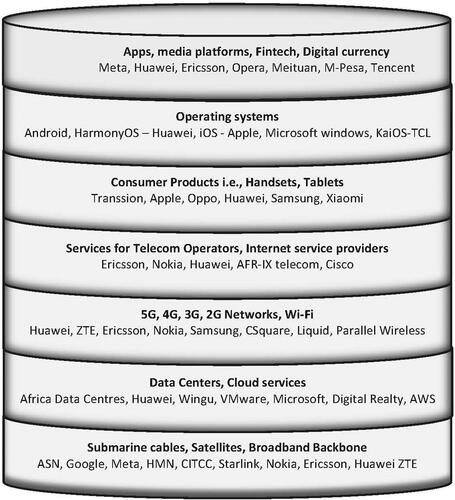
“We certainly do not deny US–China rivalry, political pressures and compellence, but many African governments adopt pragmatic policies and aim to diversify their ICT suppliers. Additionally, Western and Chinese firms sometimes have complementary interests in profiting from the exploitation of African resources, data and markets. We specifically detailed how digital development in Nigeria and Ethiopia are characterised by multiple stakeholders and various public–private partnerships, both beyond and inclusive of Chinese entities. Our claim is not that Chinese actors are outmanoeuvred, far from it, but that Chinese actors compete and coexist with a myriad of other actors. “
https://www.tandfonline.com/doi/full/10.1080/01436597.2025.2546668
🌏 🇺🇸 🇨🇳[ [OPINION: ASEAN can still hedge between America and China on AI. It needs to get its act together first]
“But a crucial question remains: Can ASEAN members draw from both the Chinese and Western ecosystems in pursuit of their own interests?The answer is: They can, to a surprising degree.So far, just two ASEAN members—Singapore and the Philippines, both longtime U.S. security allies—have signed on to the Pax Silica regime.
Yet states with significant two-way exposure to both U.S. and Chinese technologies have stayed out of the fray. These include Malaysia, with growing semiconductor packaging capacity and data center presence; Indonesia, with a sizable talent dividend and untapped renewable energy; and Thailand, with a mature electronics and EV sector with a sizable Chinese presence. Some ASEAN countries have tried to tap loopholes in semiconductor export controls. But hedging is more than just exploiting gaps…”
🇺🇸 🇨🇳[NEWS: Trump administration drafting ban on Chinese data center devices
“Trump administration is drafting a ban on U.S. imports of new models of Chinese data center components, four people familiar with the matter told Reuters, as it seeks to protect the infrastructure that undergirds the AI
[…]
The move, not previously reported, aims to prevent Chinese firms from stealing data, installing malware or disrupting service at U.S. data centers, which house the chips to train and run AI models.
The FCC could still modify or shelve the restriction, the sources stressed, speaking on condition of anonymity to discuss sensitive matters. But it is the latest example of the Trump administration trying to limit Chinese technological incursions into cutting-edge U.S. industries before they become embedded in the supply chain. “
🇨🇳[China makes breakthrough in Chips]
“CXMT is making HBM3E, an advanced type of high-bandwidth memory that is used in AI chipsets, the report said, citing two people familiar with the matter. The company plans to expand production in 2027, according to the report. Several Chinese chip designers, including Alibaba Group’s T-Head and Beijing-based Cambricon Technologies, are testing the memory with their processors, the report said”
🇳🇱[NEWS: Netherlands developing GitHub alternative?]
“Back in November 2025, Jan Vlug, a software engineer who writes for the Dutch government’s developer portal, put out a detailed blog recommending which Git forge the Netherlands should adopt for its governmental source code hosting needs.”
Forgejo came out on top due to its fully free and open source nature. Licensed under GPLv3+ and governed by Codeberg e.V., a democratic nonprofit, it has no enterprise tier, proprietary upsell, or vendor lock-in problems.
https://itsfoss.com/news/netherlands-forgejo-migration
🇨🇳[Analysis: The Real History of Beijing’s Rare-Earth Dominance]
“The Middle East has oil, China has rare-earth elements,” Chinese leader Deng Xiaoping declared in the early 1990s. This quote has been repeated a lot lately as Beijing has used its near monopoly on the rare-earth industry to effectively push back against U.S. President Donald Trump’s latest trade war. It is often cited as evidence that implicit in Deng’s statement was a coercive threat: just as Arab oil states weaponized their petroleum exports in 1973—cutting off the West to punish it for backing Israel in the Yom Kippur War—China would one day do the same with rare earths”
https://www.foreignaffairs.com/china/how-china-found-most-potent-weapon-xiong-weiss
❌ [Analysis: AI AGents and conflicts of interest]
New Stanfrod HAI brief argues that AI agents increasingly operate autonomously on your behalf — but nothing stops them from prioritizing their developers’ interests over yours. The brief argues that agents should be classified as fiduciaries and required to act in users’ best interests.
https://hai.stanford.edu/policy/designing-loyalty-ai-agents-and-conflicts-of-interest
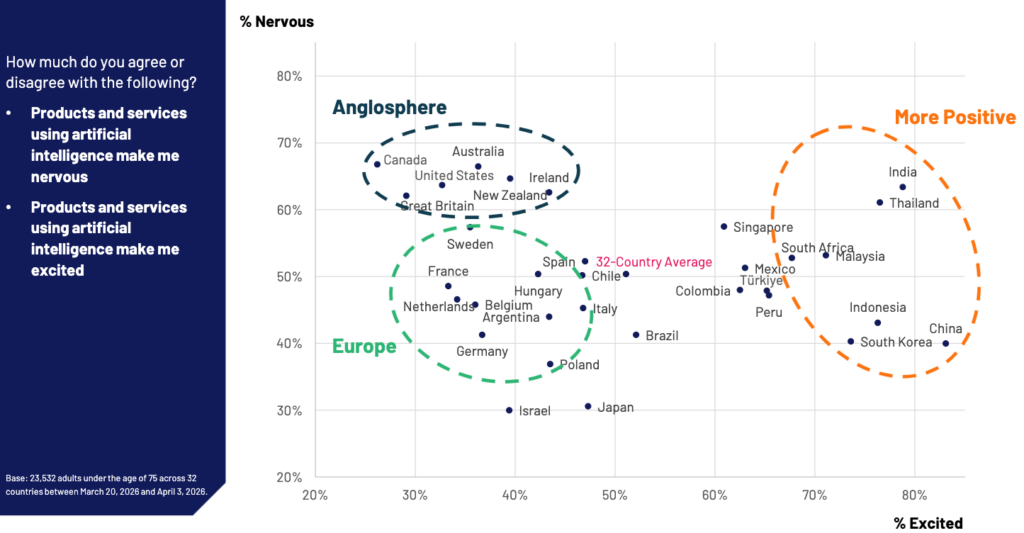
👷[Analysis: Trust gap in AI – West vs East IPSOS]
https://www.ipsos.com/sites/default/files/ct/news/documents/2026-06/Ipsos-AI-Monitor-2026.pdf
🇮🇱[NEWS: Fake US thinktank set up and funded by Israel sought to game AI for propaganda]
“In effort to prime chatbots to make pro-Israel arguments the site published 124 reports, over 560,000 words in nine days, Guardian analysis shows. The site gives Israel’s position on subjects including the torture of Palestinian prisoners, Israeli war crimes and whether Israel has deliberately starved Palestinians in Gaza, all presented as neutral research.”
https://www.theguardian.com/world/2026/aug/26/fake-thinktank-israel-ai-propaganda
🔌 [Opinion: Cable Routes as Geopolitics and Power]
“Not long ago I laid out the case that the internet is far more resilient than the security debate around submarine cables suggests — that most cable cuts pass completely unnoticed, and that even the worst-case loss of several cables at once means, for most of the connected world, a slowdown rather than a blackout. This is simply a fact about how the internet is physically built. But the moment we add geopolitics and power to the picture, it turns a lot messier. And much more interesting. (…)
“… a cable is not only a physical object exposed to physical threats; it is also a set of dependencies — on the countries it crosses, the waters it runs through, the actors who hold sway over it. “
“Redundancy has always been an engineering word. It cannot stay one. As we have seen, it has to take much more into account, including jurisdiction and geopolitics. And unlike an engineering problem, this one can never be fully solved, since it involves real conflicts of interest: one party’s greater diversity is another’s lost leverage. If a problem can only be managed and never solved, the first thing you need is to understand the fundamental forces at play…”
🇨🇳[ANALYSIS: The hottest AI models in Silicon Valley face a powerful source of competition]
“Burdened by rising AI costs, American tech companies have begun to shift to Chinese model families such as Alibaba’s Qwen, Z.ai’s GLM and Moonshot AI’s Kimi — a landmark adoption of Chinese software at enterprise scale in the United States.
“This is the first time that it’s happening,” said Rafiq Dossani, an economist at Rand. “China’s been able to catch up in software at a rate that it couldn’t do much earlier, even though [it’s] well resourced.”
ChatGPT, Claude and Google’s Gemini are all examples of “closed” AI models: The secret sauce of how they produce text is tightly guarded within their companies, and the only way to access them on an enterprise scale is to buy a subscription or use costlier pay-as-you-go pricing.”
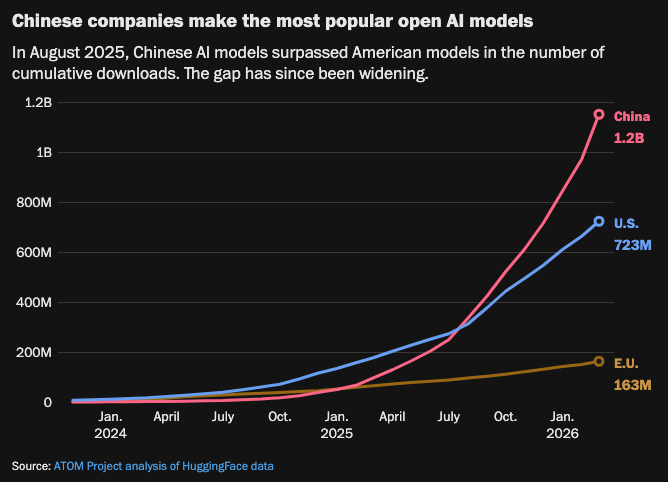
🇨🇳[Opinion: “With Moonshot’s free Kimi K3, China changes the sovereign AI playbook”]
“The best artificial intelligence technology any country can own is now available for free. On July 27, China’s Moonshot AI put its most powerful chatbot on the internet for anyone to use. The Alibabai -backed developer released the software behind its AI model Kimi K3, allowing any government, company, or individual to run it on their own computers without paying Beijing-based Moonshot. Users can also retrain the chatbot to fit their own language and laws.
Nations are spending billions of dollars to run sovereign systems or AI on their own soil so that citizen data stays within their borders and can’t be accessed by foreign companies or governments. Most countries own the machines but lease the computing power and software from U.S. companies such as Microsoft, Google, and Amazon, which count on the rent continuing for years. Kimi K3 offers those governments a way out.”
https://restofworld.org/2026/china-moonshot-kimi-k3-free-sovereign-ai
🤗 [ANALYSIS: Nvidia acquires Hugging Face after Stripe nabs OpenRouter: here’s what open source AI builders should do]
“The open-model ecosystem is not disappearing. But two multibillion-dollar acquisitions show that the neutral infrastructure developers rely on to find, download, compare and run AI models has become some of the most strategically valuable territory in technology. History suggests builders should pay attention — and build escape hatches now.
(…)
For independent developers and enterprises that deliberately embraced open models to avoid dependency on OpenAI, Anthropic, Google or another single AI lab, that should be a signal.
It doesn’t mean open source or open weights AI is about to go proprietary and closed — instead, it’s that the battle over AI lock-in is moving up a layer.
The model weights are one layer. Hugging Face increasingly represents several others: storage, discovery, versioning, documentation, model cards, download statistics, community reputation, datasets, applications, enterprise collaboration, authentication and, increasingly, inference and deployment.
Many model repositories themselves remain portable. Hugging Face’s documentation explicitly supports cloning repositories through Git and downloading model files locally. But replicating a model file is much easier than replicating an ecosystem.”
See also: https://journals.sagepub.com/doi/full/10.1177/20594364221139729
Deep Dive: Emerging new world order
🇺🇸🇨🇳[Analysis: China perceived more favourably than the US among historical US-allies]
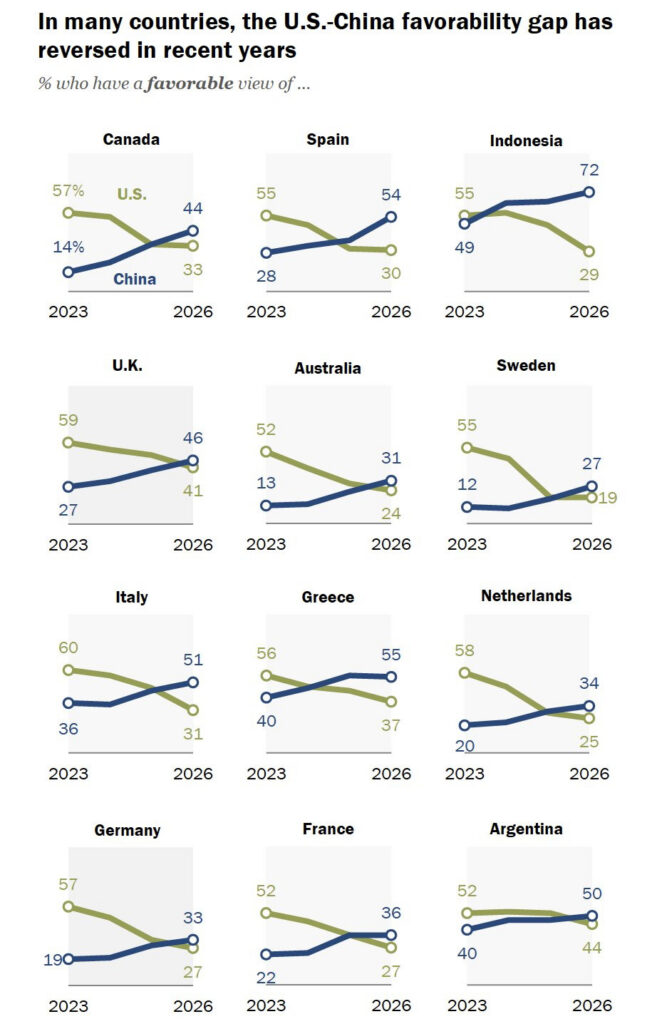
See also: China Now Outranks the United States in Global Favorability among western powers. What Happened?
“For the first time in nearly two decades, a new Pew Research survey shows China is viewed more favorably than the United States in most countries surveyed—but the findings say more about a decline in U.S. soft power than a Chinese surge.”
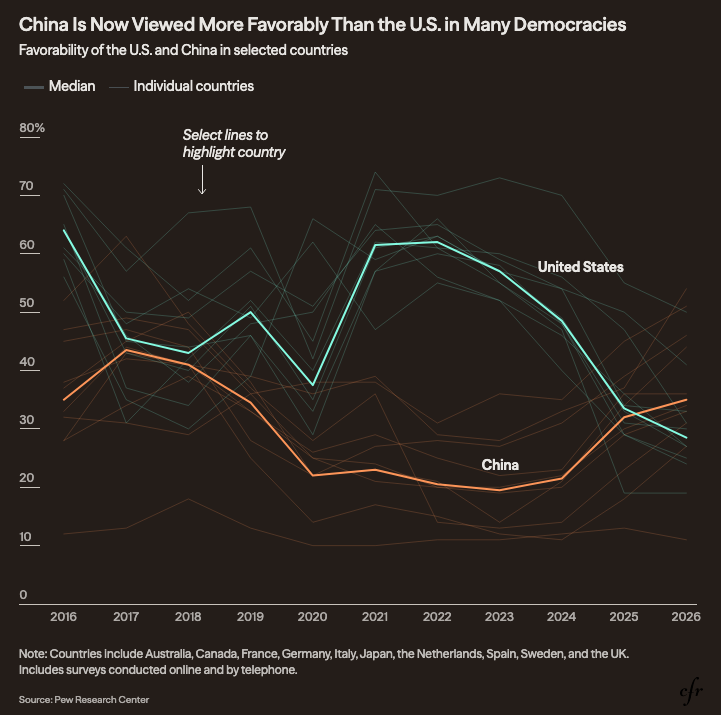
🌋 [Analysis: “A New World Order Is Coming. We Aren’t Ready”]
“what if we are already in the early stages of what will be a protracted period of disorder? A world in which we cannot assume that what was true yesterday will be true tomorrow, or that seemingly solid institutions will endure…
[…]
These are dark clouds. But the end of the old system does not have to mean the end of cooperation. We still have many of the components of an effective world order. We have a rich web of international institutions, many of them largely invisible, which manage the links among nations, from civil aviation to the internet. Treaties are still largely observed. International law and sovereignty can be hard to enforce and defend, but many of us still deplore the breaches. The very existence of an international public opinion can still put pressure on our leaders. Many of the organizations of the fading structures, among them the United Nations, the World Trade Organization and the World Bank, are increasingly drained of resources and meaning, but they still exist…”
🏁 [Opinion: end times fascism: How nationalists, theocrats and tech titans turned their backs on a shared future]
“In this way, end times fascism offers little more than the chance to believe in one of its visions of bunkered survivalism. Maybe that is the dream of merging with “superintelligent” machines and avoiding being part of what Silicon Valley coders now casually refer to as the “permanent underclass”. Maybe it’s the idea of keeping “your kind” safe inside a racially purified nation state, permanently fortressed and fortified against the needy in a burning world. Maybe (if you are wealthy enough) it’s a seat on one of Musk’s rocket ships and a Neuralink chip as he claims to safeguard our species’ fate by making us “multiplanetary”. In each case, the fate of this world — and the possibility of a shared, sustainable future — is being written off.”
https://www.ft.com/content/bd134250-00d8-4bfd-bf4b-d32479ac0fed
🪚 [Opinion: A digital iron curtain is threatening the global economy]
“‘…If the conditions are right, factories can adapt designs that they know work for local needs, better processes can spread and products can reach new markets without having to rebuild from scratch each time. That logic is strong enough to encourage corporate competitors to build connections that will allow technology to work across national boundaries.
Shared standards are the cleanest way to do this: everyone works to the same rules from the start. Interoperability is the next best solution, allowing different systems to work together without becoming identical. Take a recent European-Japanese effort that linked separate automotive industrial networks while each retained its own architecture.
Yet while companies are building bridges, geopolitics is increasingly drawing borders. The US-China technology divide is reshaping the landscape worldwide as governments seek greater control over technologies, data and supply chains. Export controls, data localisation rules and diverging cyber security requirements are drawing new lines through global technology. Every new barrier makes it harder to connect systems, scale what works and bring better products to markets. If this trend continues unchecked, digital borders could harden into a digital iron curtain — slowing progress, trade and the exchange of ideas between societies…’”
https://www.ft.com/content/90550cee-2dd4-437f-8bda-b1ff41317d23?shareType=nongift&syn-25a6b1a6=1
🚪 [Opinion: “The Abandoned Order – Learning to Live in a Post-US World”]
“U.S. Secretary of State Henry Kissinger once asserted that world order rests on two pillars: a reasonably stable balance of power and a set of commonly agreed-on rules about what states may or may not do. Today, both pillars are crumbling, and it is unlikely that they can be fortified or rebuilt any time soon. The United States remains the world’s preeminent military, economic, and technological power. But it is increasingly clear that Washington no longer has the ability to prevent conflicts or ensure the free flow of commerce worldwide; it could not even open the Strait of Hormuz after a militarily hobbled Iran shuttered the waterway.”
https://www.foreignaffairs.com/united-states/abandoned-order-world-mark-leonard
Sign-up/Unsubscribe:
Sign up here to get the NATM newsletter in your inbox!