Curated by Juan Ortiz Freuler / Sign up / Submit contributions / Oct 2026
🍿 [DOCUMENTARY: What happens when countries stand up to super powers? Bandung 1955, a 12 min documentary by Al Jazeera]
🇺🇳 [Analysis: What Non-Western Governments Said About AI at the UN]
“While governments in the United States and Europe debate how to regulate and slow the development of frontier AI, countries across the rest of the world are approaching the question differently.
At the United Nations General Assembly High-Level Week last week, governments called for a greater role in shaping AI rules, expanding access to AI capacity and ensuring that efforts to make AI safer do not deepen existing technological divides. Pakistan, for example, backed calls to pace frontier AI while warning that “pacing must not become a new form of gatekeeping.”
[-Access breakdown of country statements through link at the end of segment]
- Call for Control of Frontier AI Models — Launched by Finland and Norway on Sept. 21, calling for pre-deployment testing, independent evaluation, common standards and exploration of an international institution. The Norwegian government says 22 leaders supported the appeal at launch.
- Partners for Multilateralism (P4M) Declaration — A multilateralism and UN reform declaration — not specifically an AI governance initiative — co-signed by the EU, Kenya, Australia, Barbados, Canada, Brazil and India.
- UN Independent International Scientific Panel on AI — Barbados will host the second in-person meeting of the panel in November 2026.
- Japan AI Summit — Japan intends to host an AI Summit “at the earliest opportunity,” Prime Minister Takaichi told the UNGA.
- UK G20 AI presidency — Prime Minister Andy Burnham said the UK will put AI at the heart of its G20 presidency next year, seeking a single set of global principles and standards.
- Geneva AI Summit — Announced by Switzerland for June 21–22, 2027 at Palexpo in Geneva. Theme: “Bridging Innovation and Trust.”
- Second UN Global Dialogue on AI Governance — New York, May 3–4, 2027.
https://www.techpolicy.press/what-nonwestern-governments-said-about-ai-at-the-un
🧱🇮🇳 [NEWS: BRICS Summit in India]
“Prime Minister Narendra Modi warned on Sunday that the “weaponisation” of technology and critical minerals could hinder shared prosperity, urging BRICS to rise through cooperation even as its leaders unveiled mega plans, including an open-source AI ecosystem to assist the Global South.
[…]
In his address, Chinese President Xi Jinping announced that China will lead the creation of an open-source AI ecosystem for BRICS member nations as part of a five-point initiative to boost cooperation in technology, manufacturing and trade.
Xi also said that BRICS should leverage its close ties with emerging markets and the Global South to safeguard supply chains and build a large integrated market.”
🧱 [Analysis: “BRICS AI cooperation moving toward practical results “]
“India hosts the summit of the group of world’s emerging economies, BRICS, from September 12th to 13th. Artificial intelligence is an increasingly important area of cooperation within BRICS. Efforts are focused on technology development, talent training and AI governance. An expert says member countries can see more practical results in the coming years. Huang Yue reports.
Artificial intelligence has become an increasingly important area of cooperation among BRICS countries, a major grouping of emerging markets and developing economies. The China-BRICS Artificial Intelligence Development and Cooperation Center, established in 2024, is one of the mechanisms created to promote cooperation in the field. The center has since expanded its work to areas including research, talent training, innovation and industrial cooperation.”
https://news.cgtn.com/news/2026-09-10/VHJhbnNjcmlwdDkyMzQ3/index.html
🧱 [OPINION: “In BRICS open-source AI, China and India will make a good team”]
“…His proposal envisaged cooperation in developing and applying large language models, conducting AI training and seminars and constructing a more open AI ecosystem. He also called for a broader international framework for AI governance. Although India has not yet publicly endorsed the specific China-led initiative, there is considerable conceptual convergence between China’s proposal and India’s own emphasis on making AI more accessible, inclusive and oriented toward global development.” https://asiatimes.com/2026/09/in-brics-open-source-ai-china-and-india-will-make-a-good-team/
🇵🇭 🇺🇸 [NEWS: Groups hold anti-Pax Silica protest in Philippines]
“Philippines not for sale! Uncle Sam go away!”
Protesters repeatedly shouted those words as they marched along the road to Clark Freeport Zone at Barangay Balibago in Angeles City on Friday.
Holding banners demanding the rejection of Pax Silica, the protesters held a short program in front of the former United States military base, citing the 1,600-hectare project’s impact on farmers, indigenous tribes, the environment, and sovereignty”
https://newsinfo.inquirer.net/2303644/groups-hold-anti-pax-silica-protest-in-angeles-city
🇨🇳🌍 [Analysis: How China-Africa Relations Are Shaping the Geopolitics of AI]
“China’s AI development efforts are unfolding alongside its expanding economic influence on the African continent. Over the past two decades, China has progressed from an emerging donor in Africa to the continent’s largest bilateral creditor. Its strategic position on the continent is creating opportunities for its economic partnerships to intersect with its broader global AI ambitions.
To this end, China has deepened and leveraged its economic relationship with African countries in various ways, from educational programs to political exchanges. Of these, however, critical minerals, foreign direct investment in digital infrastructure, and market penetration for Chinese AI models stand out as among the most important.”
https://www.techpolicy.press/how-sinoafrican-relations-are-shaping-the-geopolitics-of-ai
🇷🇺🇪🇺 [NEWS: “NATO allies foil Russian subsea cable sabotage plot”]
“Deep in Arctic waters near the remote Svalbard archipelago this spring, NATO allies caught Russian subs training to unleash a secret weapon designed to disable critical undersea cables without leaving any fingerprints.
The clandestine Russian operation, described to Reuters by two Western officials, was carried out by Moscow’s GUGI undersea warfare directorate, which used deep-sea submersibles to simulate the deployment of the sophisticated and destructive technology.
Some U.S. intelligence analysts are increasingly concerned Russia may test NATO’s mutual defence pact, known as Article 5, three U.S. officials said. If it does, destroying subsea cables could be a critical part of that effort, the Western officials said.
Cables no thicker than a garden hose, lying on the seabed or buried just below, are critical to global internet connectivity and financial transactions. Their economic and strategic importance has made them targets in past conflicts, including in the First and Second World Wars, when they were critical to delivering orders by telegraph or telephone.
Two 1,400 km subsea fiber-optic cables linking Svalbard to mainland Norway lie as deep as 2,700 metres below the sea’s surface. They carry vast amounts of satellite data downloaded at the SvalSat satellite ground station, the world’s largest and part of NASA’s Near Space Network.”
https://www.reuters.com/world/europe/nato-allies-foil-russian-subsea-cable-sabotage-plot-2026-09-10
🪖 [OPINION:Forget ‘superintelligence’: error-prone AI nearly sparked world war three this month”]
“While so many of us were focused on fictional superintelligent machines that we were told could hypothetically cause human extinction, however, there was a more serious story being reported.
A series of events almost got us to armageddon, not caused by “rogue, superintelligent AI”, but by government reliance on error-prone systems that are marketed by their manufacturers as being close to superintelligent.
A CNN report published on 18 September, which hasn’t been verified by other major outlets, describes how the US “almost started a war” with China, based on an intelligence report that claimed a Chinese ship was transporting components of nuclear weapons. Military personnel made plans to intercept the Chinese vessel, complete with aircraft and soldiers ready to board the ship. A military skirmish of this kind between China and the US could quickly escalate and spiral into world war three.
It was only moments before executing on the plan that American officials further investigated the intelligence report and found that it had been generated with the use of a chatbot and contained erroneous information about the vessel’s contents.”
[…]
“It is high time for us to regulate usage of systems sold as “AI”, not because they are magical machines, but because they are error-prone products that shouldn’t be used in high-stakes scenarios. Any automation used in military, medical or other life-and-death situations must be thoroughly evaluated within its use case and paired with usage norms that keep accountability with people who have actual power to make decisions.”
🤗 [NEWS:Hugging Face approached Nvidia’s Huang weeks ahead of $12.9B acquisition, CEO tells CNBC]
“Nvidia has officially agreed to buy open-source artificial intelligence platform Hugging Face for $12.9 billion, as the chipmaker moves beyond hardware and further up the AI stack.
With the deal, which has been expected since The Information reported on it last week, Hugging Face will “remain an open platform for the entire AI ecosystem,” Nvidia CEO Jensen Huang wrote in a blog post Thursday.
“Together, we will scale Hugging Face’s platform, strengthen its infrastructure and expand access to AI for developers and institutions worldwide,” Huang wrote.”
🦾 [NEWS:AMD will acquire Fei-Fei Li’s World Labs for $8.2B]
“AMD is acquiring World Labs, one of the leading developers of deep learning models intended to understand physical reality, in an $8.2 billion deal, the two companies said today.
World Labs justified the deal in a statement saying that AI development required “close collaboration across model research, systems and compute.” AMD, in turn, says that understanding frontier workloads, like those created at World Labs, will shape its chip-making roadmap. The acquisition will see World Labs founder Fei-Fei Li join AMD as executive vice president and chief scientist. AMD and World Labs formed an inference optimization-and-training partnership last year, and ties have remained close. https://techcrunch.com/2026/09/28/amd-will-acquire-fei-fei-lis-world-labs-for-8-2-billion/
🇺🇸📱 🇬🇧 [NEWS:US lawmakers call for UK court to lift secrecy over Apple ‘backdoor’ surveillance”]
“US lawmakers are urging a UK court to lift the secrecy around UK government moves to require Apple to create a “back door” into its end-to-end encrypted data storage, ahead of a court hearing next week.
In a letter to the Investigatory Powers Tribunal, US Democratic senator, Ron Wyden, and Republican Warren Davidson, warned that the UK’s unprecedented secrecy is needlessly straining the relations between the two countries.
The letter comes ahead of a case management hearing by the Investigatory Powers Tribunal that will consider a new complaint by Apple against the Home Office over a secret order to give the UK access to end-to-end encrypted messages, photographs and data stored on Apple’s iCloud service“
🇺🇸 🎥 [NEWS:Anthropic Is Building a Predictive Surveillance System to Monitor Activists]
“Job postings and interviews with senior security officials at Anthropic show that the frontier AI lab is building out an extensive monitoring system to keep tabs on activists who oppose the rapid development of artificial intelligence.
In addition to monitoring activists in the vicinity of Anthropic executives and keeping tabs on protests near physical Anthropic assets, the firm is also implementing a “pre-crime” approach, attempting to predict incidents before they happen. In some cases, that also means reporting suspects to police before a crime occurs. Anthropic did not respond to the Prospect’s request for comment.
Anthropic’s plans to surveil dissent are at odds with the firm’s efforts to cast itself as the responsible alternative to OpenAI. At the beginning of the year, the Department of Defense and Anthropic engaged in a high-profile dustup over Anthropic’s refusal to allow the military to use its tools for mass domestic surveillance and autonomous weapons. That tension seems to have eased as Anthropic hires for “national security sales” positions, seeking to restart military contracts. The increase in threat monitoring of domestic opponents fits with a renewed focus on national security.”https://prospect.org/2026/09/09/anthropic-artificial-intelligence-surveillance-system-monitor-activists/
🇮🇷🇧🇭 🇦🇪 [NEWS: Amazon says cloud infrastructure in Bahrain, UAE ‘beyond saving’”]
“Amazon Web Services (AWS) says it cannot restore access to its cloud-computing facility in Bahrain or one of three data-hosting zones in the UAE due to the extensive damage caused by Iranian retaliatory strikes, Reuters reported on 15 September.
“The damage to our infrastructure spanned multiple Availability Zones and exceeded what our regional and multi-AZ services are designed to withstand,” AWS reported in its status update seen by Reuters.
In the UAE, resources and data held exclusively within one zone, labeled mec1-az2, have been damaged beyond hope of recovery, the company said, as engineers are still salvaging what they can from the two other battered zones and across the wider Emirati region.
An availability zone refers to a cluster of one or more data centers sitting inside the same geographic region, the structure AWS relies on to keep services running when a single site goes down.”
https://thecradle.co/articles-id/39961
🇮🇱 🇵🇸 [NEWS: Gaza before and after: New Google Maps imagery shows destruction of the Strip]
“For the first time in over a year, Google Maps has updated its satellite imagery of the Gaza Strip, allowing anyone with the app to see how a territory devastated by the Israeli military has changed. By updating imagery in 2024, 2025 and now 2026, Google has taken a step that other apps such as Apple Maps have not.
Simply opening the app’s map viewer lets you survey the destruction as it was earlier this year: entire neighborhoods flattened by bombs and excavators, dirt tracks cutting through what were once residential areas, and zones reduced to rubble, such as Tel al-Sultan in the southern Strip, where barely 10 buildings remain standing.
[…]About 650,000 people lived in Gaza City, the capital, before the Israeli offensive that followed the Hamas-led attacks on October 7, 2023. By October 2025, 83% of the city’s buildings had been damaged by Israeli operations, according to a preliminary analysis by the UN Satellite Centre (UNOSAT).“
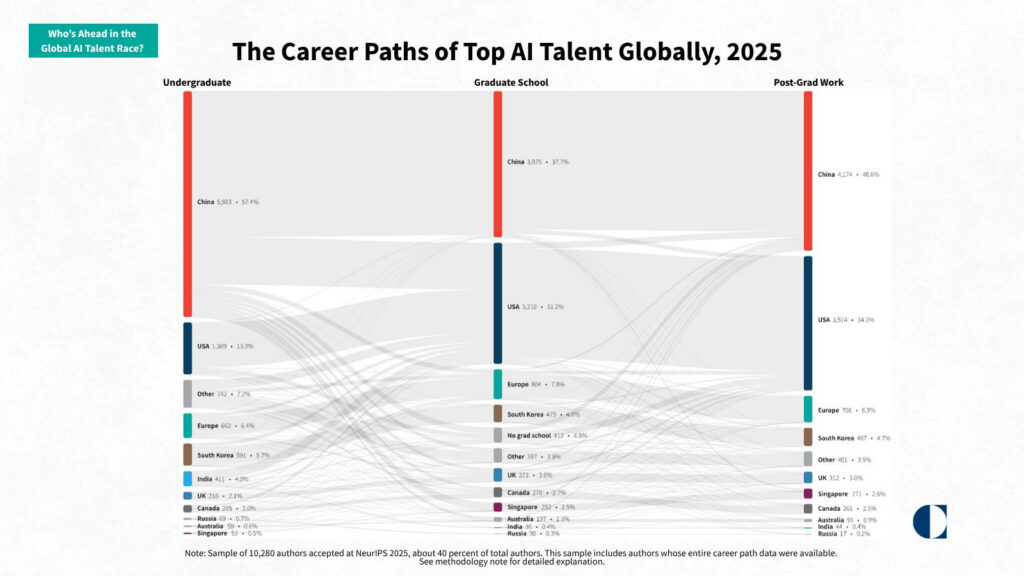
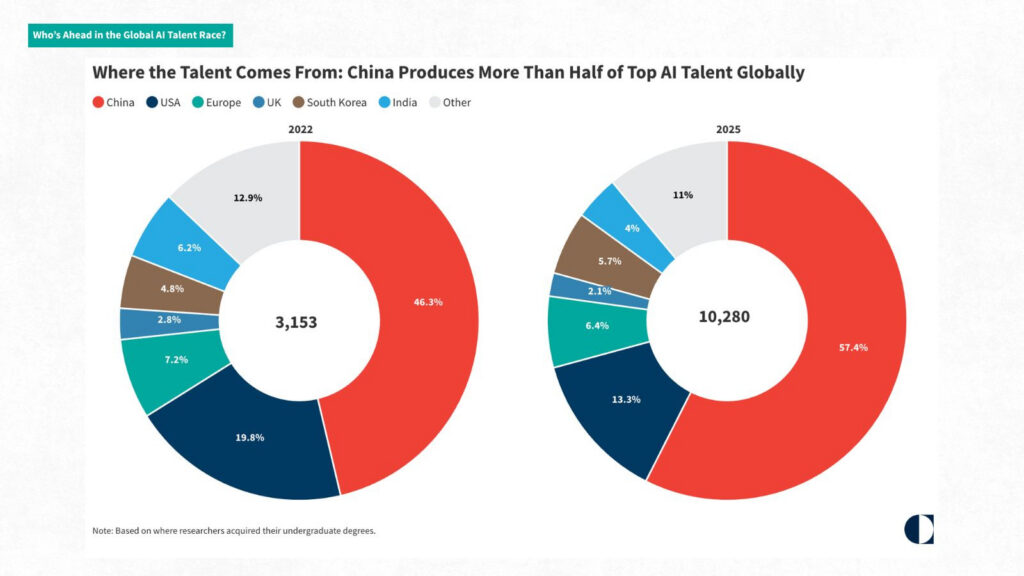
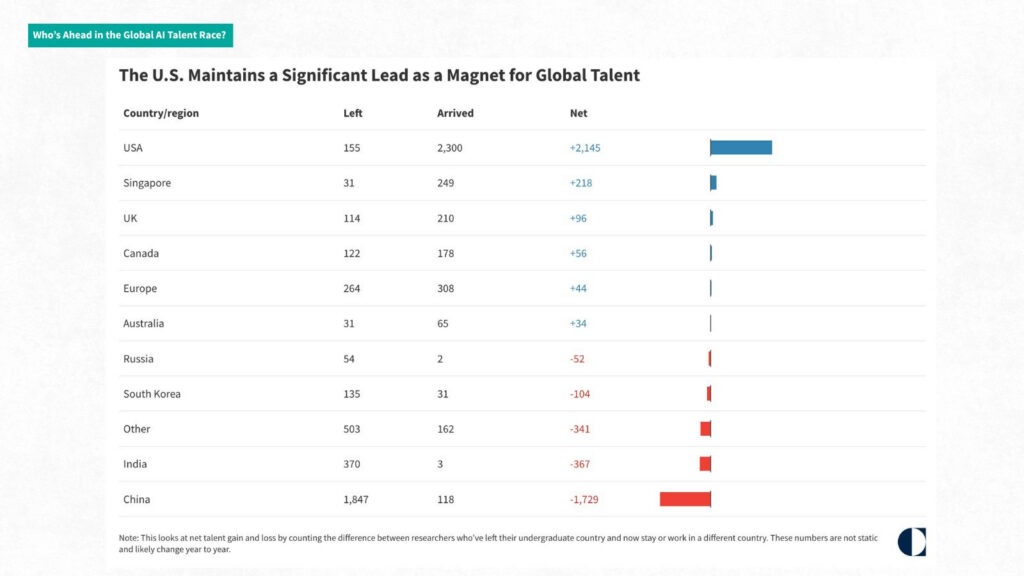
🇨🇳🇺🇸 [Analysis: Career paths of top AI talent]
57% of top AI talent originate from China, up from 46% in 2022. 13% of top AI talent originate from the US, down from 20% in 2022. China’s lead as a source of top AI talent has widened since 2022.
https://carnegieendowment.org/features/whos-ahead-in-the-global-ai-talent-race
💵 [OPINION: “An AI sovereign wealth fund isn’t progressive — it’s techno-imperialism“
“Shutting Beijing out allows US AI companies to capture enough profits that a public fund would be able to redistribute them. Such a fund would be no custodian of collective intelligence but a collector of geopolitical rent: the yield on keeping China’s AI down and the world’s AI bills up.”
[…]
Critics from Sanders to Steve Bannon are right about the disease: AI breeds oligarchy. But a dividend funded by flexing American muscle while underdeveloping the rest of the globe would not cure it. It would solve one injustice by hiding another, and give oligarchs what they’ve never had: a public with a stake in looking away.”
https://www.ft.com/content/bc178357-793b-45d8-ae3b-d5929159c243
💥 [Opinion: “Destroy AI”]
“The history of class struggle from the Luddites to the Writers Guild of America shows that the emancipatory potential of technology never comes from the technology itself. It comes from building enough power to fundamentally remake these infrastructures. Hence the recent movement for digital sovereignty: public clouds and computational models with transparent safety frameworks which are democratically designed, rather than imposed by the superrich. The Non-Aligned Technologies Movement aims to translate this demand into an international campaign against the unequal digital world-system.
For such movements to succeed, they would need to be aided by a state-led industrial strategy to decommission data infrastructure or reorient it towards socially necessary functions, set by workers and users.”
https://tribunemag.co.uk/2026/09/destroy-ai
🇮🇳 [Opinion: The deterioration of India-US relations, according to Former Indian ambassador to the US]
“In relations between states, as in personal relations, come moments of great clarity when situations must be assessed without excuse, apology or gloss. The Russia sanctions law is such a moment in the India-US relationship, badly buffeted as it is over the last 20 months. It is now time to apply the cold edge of the scalpel, cut the fat and get to the heart of the matter. Acceptance of the problem is crucial to any resolution. We need to accept, without caveats, that the relationship has cratered significantly. In America’s eyes, India is not the strategic partner that we believed we were. Acceptance of this reality means casting overboard long held predilections and comforting wishful thinking.
Then the granular aspects of this acceptance. It is self-deluding to put the blame solely on Donald Trump. Implicit in that approach is the naïve belief that if today he, like Clint Eastwood of yore, rides off into the sunset, our relations will snap back to a golden age. Let us accept that what we are seeing goes beyond even the most destructive personality. Economic nationalism, racial supremacism, moral poverty, naked aggression and wanton disregard for international law and norms are trends which will outlast Trump; on many issues the centre has moved in American politics. A Vance or a Rubio or a Democrat successor may not be much different, though a tad predictable. The passage of the bill, and the amendments proposed, was a display of imperial arrogance from the Hill. Votes in favour of punishing India—along with four other countries—for buying Russian oil cut across party lines, including in the Congressional India caucus; even one Indian-American congressman in the ‘Samosa caucus’ voted in favour.
Let us accept that the bipartisan consensus on the India partnership, built assiduously over a quarter century, has developed a crack.
🇮🇳 [OPINION: For India to matter in BRICS, it must reclaim the spirit of Non-Alignment]
“NAM survives in name; its purpose has been abandoned. On paper, it has 120 members and holds summits that few notice.
Into this vacuum has come BRICS. Formed in 2009 by Brazil, Russia, India and China, joined by South Africa and more recently by Egypt, Ethiopia, Iran, Indonesia and the UAE, it now represents more than half of humanity and roughly a third of the world economy. The 18th Summit in New Delhi last week produced a 140-point declaration that reads, in places, like an echo of Bandung – reform of the Security Council, the IMF, the World Bank and the WTO; condemnation of unilateral sanctions; an end to the blockade of Cuba; a Palestinian state on the 1967 borders with East Jerusalem as its capital; climate finance for countries that did not cause the climate crisis.
But let’s be honest, BRICS is not the heir to NAM’s anti-colonial mission. Its members have very different systems and interests, and several are close partners of the United States.” https://indianexpress.com/article/opinion/columns/for-india-to-matter-brics-it-must-reclaim-spirit-non-alignment-10890537/
🗞️ 🇮🇳 [Journal article: On digital non-alignment]
“In a digital era, how are states aligning themselves in order to maximize digital prosperity while minimizing digital vulnerability? This article argues for ‘digital non-alignment’ as the best concept for understanding how states are addressing this question, using India as a case-study. Neo-realist International Relations (IR) theory and concepts that derive from it, such as digital sovereignty and even data imperialism, fall short in enabling a rich understanding of states’ options. Digital non-alignment offers an improved theoretical framework for understanding state behaviour in a digital era characterized by interpenetration of private and public (including defence) sectors and the necessity of relatively open domestic markets. A first section identifies lacunae in IR theoretical frameworks that can be filled by digital non-alignment. A second section examines in detail the development of digital non-alignment in India, a key actor in the development of pre-digital as well as digital non-alignment. A conclusion proposes that, while digital non-alignment has had its fullest development to date in India, many other states are also deploying the concept. This points to possibilities for further research, particularly but not exclusively in the global South, into how states manage interstate competition in the digital landscape.”
https://academic.oup.com/ia/article/102/5/1721/8785705?login=true
📖 🇮🇳 [Book:Computing in the Age of Decolonization: India’s Lost Technological Revolution – By Dwaipayan Banerjee]
“India today is widely recognized for producing world-class tech talent and Silicon Valley leaders, yet captures only a fraction of the global tech industry’s profits, primarily providing skilled but inexpensive labor for Western corporations. Computing in the Age of Decolonization uncovers the overlooked history behind this paradox, tracing India’s ambitious but ultimately thwarted drive to build a self-reliant computing industry from the 1950s to the 1980s.
After independence in 1947, Indian scientists and policymakers at institutions such as the Tata Institute of Fundamental Research saw computing as central to national sovereignty, economic growth, and scientific advancement. Through projects such as the groundbreaking TIFRAC computer and the decisive expulsion of IBM, they aimed for technological independence. But almost immediately, these initiatives faced powerful political and economic headwinds. Indian computer scientists grappled with Cold War politics, international trade imbalances, US corporate monopolies, and strategic decisions by India’s technocratic elite, who favored profitable technical services over costly investments in research and manufacturing.
In narrating this lost future, Computing in the Age of Decolonization shows that genuine technological independence requires more than technical expertise—it demands addressing enduring political and social structures rooted in colonial legacies. As global struggles over technology intensify, this book reveals how historical pathways continue to shape contemporary battles for technological and economic sovereignty.”
https://press.princeton.edu/books/hardcover/9780691268217/computing-in-the-age-of-decolonization
📖 [BOOK: Predatory AI: How We Can Resist Corporate Capture of the Human Mind – by Nick Couldry]
“We are told that AI is inevitable, a revolutionary next stage in planetary intelligence. The calculative power that Big Tech is harnessing via its AI products cannot be doubted. But what if humanity is entering into the wrong social contract with AI?
A good future for humanity cannot mean inputting our lives into predatory AI models whose terms we don’t control. It cannot mean trading away our own cognitive resources – and the power to define the future direction of the human mind – to corporations. It cannot mean ever greater cognitive dependence on business products, while ignoring the implications for environmental sustainability.
A good future with AI must mean putting social, community and planetary values first. This book imagines a different social contract with AI, and a different future.”
📖 [BOOK: Deep Connections: The Hidden Battles to Control Subsea Cables – By Katja Bego]
“Deep beneath the world’s oceans lurks a threat with the potential to cause major disruption and conflict: a network of cables through which almost all global internet traffic runs. These invisible but vital assets, spanning almost 1.4 million kilometres, are increasingly under siege by tech giants fuelling an AI bubble and state actors vying for control and seeking to undermine their geopolitical adversaries.”
📢 [Call for working papers]
- Call for working groups due October 15, Finnish Society for Development Research’s annual conference 2027 “Empowering Development: People and Nature in the Era of New Technologies and Geopolitics” https://www.kehitystutkimus.fi/conference/
- Contact: Christopher Chagnon on behalf of the Finnish Society for Development Research, info.developmentdays@gmail.com
[sent via NATM submission survey]
🫂 [NATM Meetups:]
🇨🇦 Society for Social Studies of Science (4S) in Toronto (October 7-10, 2026):
“How can the study of dependency theory enhance digital sovereignty?” – co-organized with Guilherme Cavalcante Silva, Paola Ricaurte, Marco Trigoso, and Raúl Zambrano.
Reach out to Guilherme Cavalcante Silva (gcsilva@yorku.ca ) or Juan Ortiz Freuler ( juanof@protonmail.com) for more information.
🇲🇽 Asociation for Internet Researchers (AoIR) in Mexico City (October 2026):
Two events:
- Oct 14: Pre-conference workshop on Dependency Theory and Non-Alignment coordinated by the NATM dependency theory working group.
- Oct 15: Panel on the Non-Aligned Tech Movement at the Association for Internet Researchers (AoIR) taking place in Mexico City. [Chaired by Juan Ortiz Freuler and Ulises Mejias].
Reach out to Luciana Musello, Guilherme Cavalcante Silva, or Juan Ortiz Freuler for more information (lmusello@usfq.edu.ec, juanof@protonmail.com, gcsilva@yorku.ca )
🇺🇸 🏗️ Graphical Deep Dive: The massive US investment in datacenters: AI or bust?
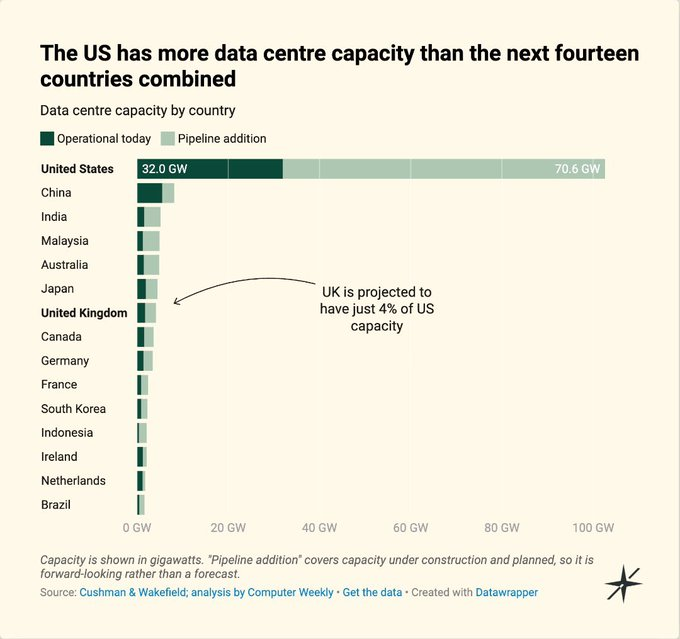
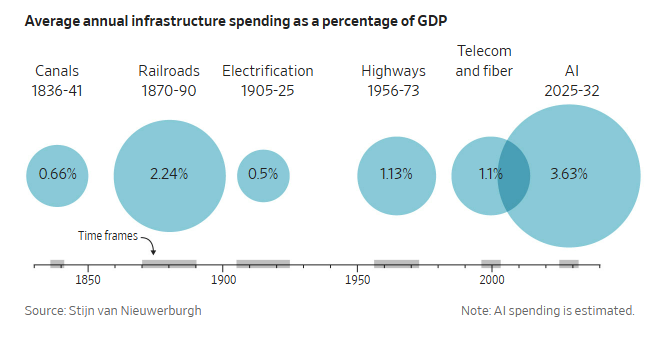
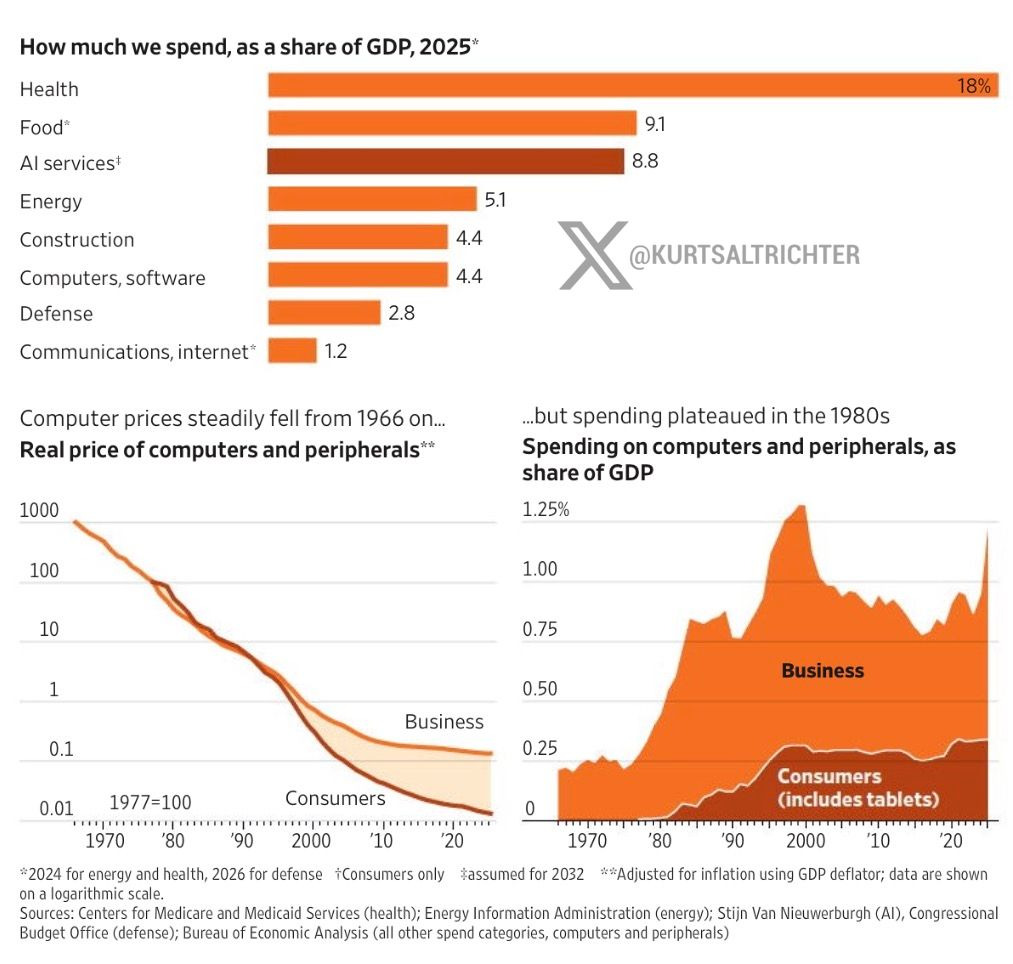
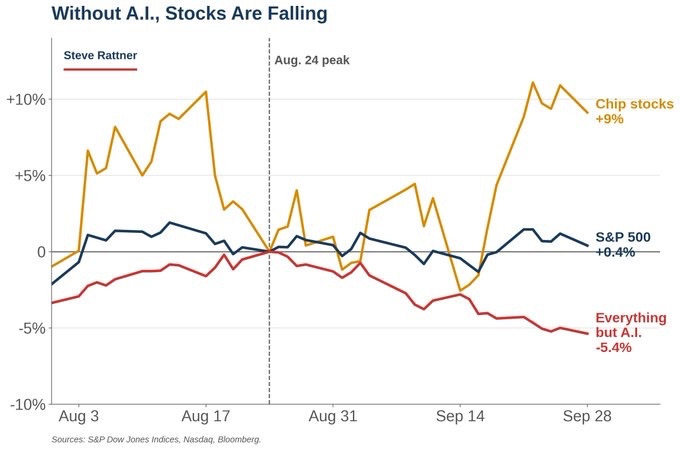
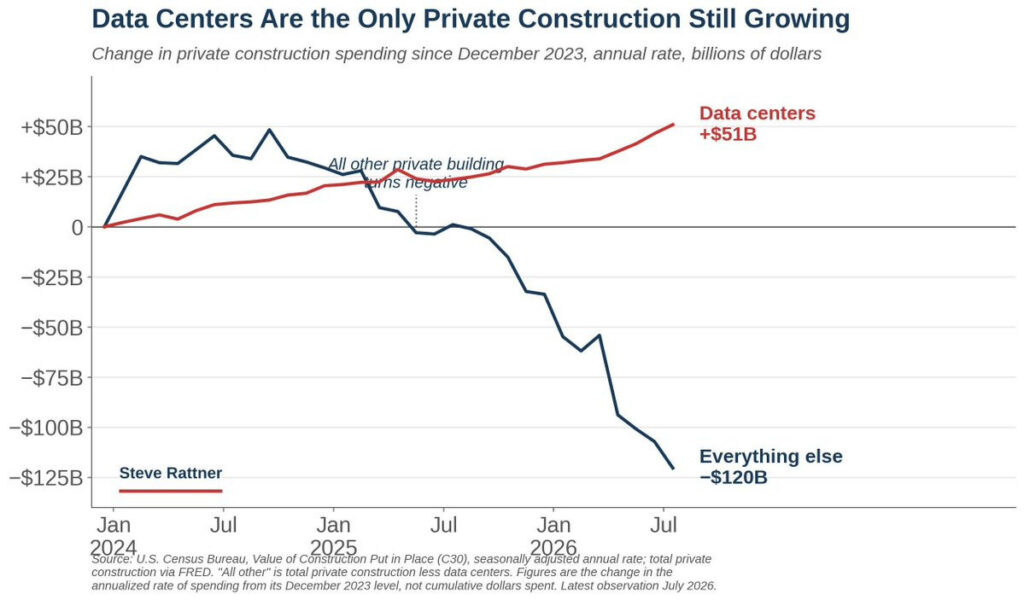
Interactive graphs on the circular investments
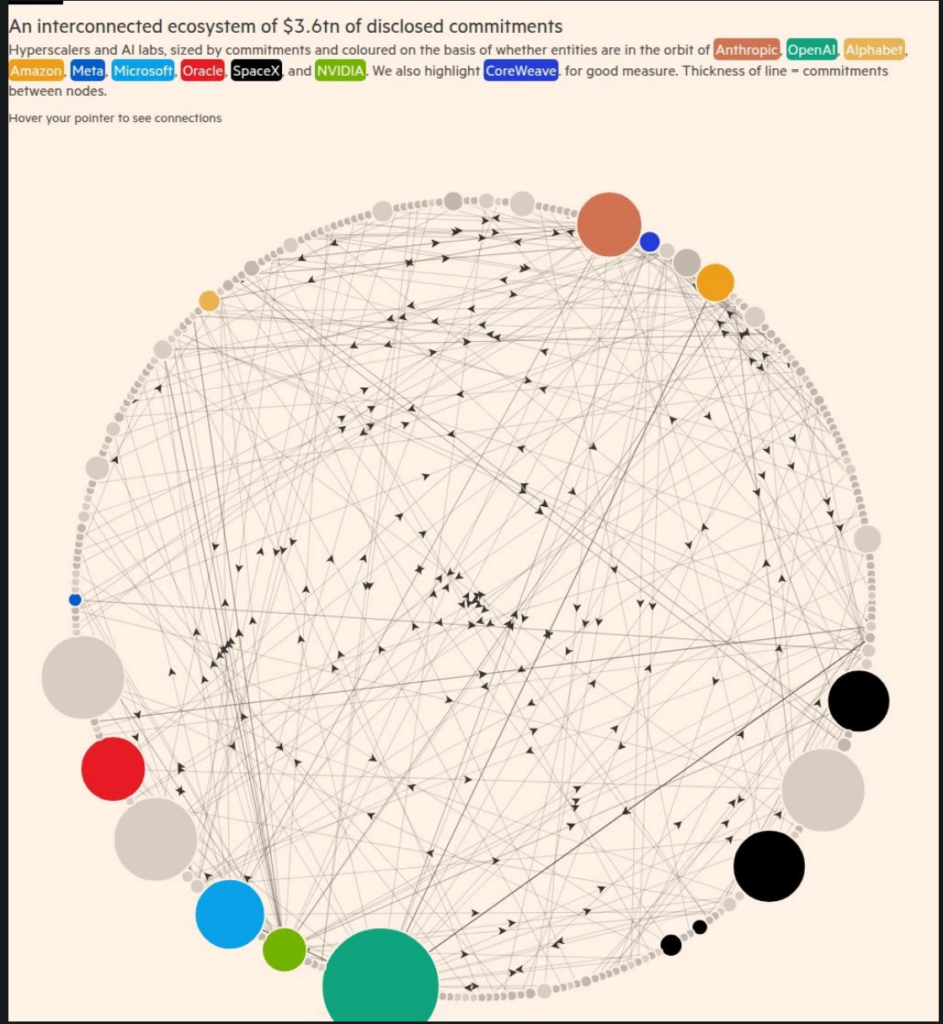
https://www.ft.com/content/8475dc9b-b2d4-4e10-a6b6-12796b11758a?shareType=nongift
Sign up here to get the NATM newsletter in your inbox!