Curated by Juan Ortiz Freuler /Sign up / Submit contributions
🇺🇳 [UN WSIS Meeting coming up July 6-10!]
Background: The United Nations General Assembly recognizes the central role of the WSIS Forum as a global platform for advancing the World Summit on the Information Society vision. Through resolution A/RES/80/173, the General Assembly acknowledged the work of ITU, in collaboration with UNESCO, UNCTAD and UNDP, in establishing the annual WSIS Forum.
Agenda: https://www.itu.int/net4/wsis/forum/2026/
🇺🇸[NEWS: US places and then lifts export controls on latest Claude AI model]
The export controls:
“Late Friday, June 12, the Department of Commerce sent a letter to Anthropic informing the AI developer that it was imposing export controls on its latest models, Fable 5 and Mythos 5. An approved export license from the Bureau of Industry and Security (BIS), the Commerce component responsible for implementing major aspects of the U.S. export control regime, is now required for any foreign persons, whether inside or outside of the United States, to access the models. The requirement includes Anthropic’s foreign national employees”
The reactions:
“When it comes to India, foundational AI technologies are being viewed as critical infrastructure, meaning sudden disruptions could paralyse long-term projects, public utilities and financial systems.”
“For Europe, the timing stung. Only days earlier, Anthropic had been in talks to give the EU’s cybersecurity agency, ENISA, access to Mythos, which would have been the first time the model was extended beyond the US and the UK. European governments, companies, and research institutions that had gained access under Anthropic’s Project Glasswing, ENISA and NATO among them, were cut off with no notice and no timeline for return. The order spared no allies.”https://thenextweb.com/news/eu-white-house-anthropic-mythos-talks
Export controls lifted:
“Anthropic said on Tuesday that the U.S. Department of Commerce has lifted export controls on its Claude Fable 5 and Mythos 5 models, ending the latest dramatic standoff between the artificial intelligence company and the Trump administration.
[..]
The government’s crackdown on Anthropic coincided with a swift rise in Chinese open-source models that are proving to be almost as capable and significantly cheaper than some of the most powerful U.S. models. With the Trump administration limiting Anthropic’s rollout of its latest models, a number of tech executives and investors raised concern that Chinese developers were being gifted valuable time in their effort to catch up…”
🇪🇺🔄🇺🇸 [NEWS: EU joins non-binding US-led Pax Silica AI-supply chain declaration targeting China]
“The European Commission, on behalf of the 27 EU countries, signed the US-led Pax Silica initiative on Tuesday, a non-binding declaration aimed at excluding China from artificial intelligence-capable semiconductor supply chains. The objective of Pax Silica is still unclear. The initiative is a non-binding declaration of intent, but does not include concrete proposals. The Council of the EU gave the Commission a green light earlier this month to sign the declaration after months of internal negotiations over the implications of Pax Silica. Following a US confirmation that the declaration was non-binding, the Commission received a mandate to negotiate.”
https://www.euractiv.com/news/eu-signs-us-pax-silica-initiative-singling-out-china-on-ai-chips
[See also, Newsletter #26 and #24]
🇪🇺↔️🇨🇳[News: “EU needs a ‘dedicated instrument’ to unwind China dependencies, trade chief says]
“The EU’s trade chief has confirmed publicly for the first time that the bloc is considering a specific rule to compel companies to diversify their suppliers, as Europe looks to unwind its dependencies on China. “Diversification now requires a dedicated instrument,” Trade and Economic Security Commissioner Maros Sefcovic said on Friday, adding that he would model it on the manner in which the EU reduced its reliance on Russian energy following its invasion of Ukraine in 2022.
“Recent industrial cases, in particular supplies of chips and rare earths, have reinforced my conviction that a step change is necessary. We understand the urgency for critical minerals, but every high-risk sector must be weaned off single-supplier dependence,” Sefcovic said, in a speech at the Brussels Economic Security Forum. The remarks appeared to allude to Beijing’s export controls on critical minerals and semiconductors amid a China-US trade war and a dispute with Netherlands-based chipmaker Nexperia last year. Each round of controls brought parts of European industry to the brink of pausing production.”
🇬🇧↔️🇺🇸[NEWS: NEW UK Prime Minister sketches AI policy to move away from US dominant players]
“As first reported by Financial Times, Burnham advisers are drawing up plans to overhaul the UK’s AI strategy and move away from what they describe as a U.S.-centric model associated with former Washington ambassador Peter Mandelson. People briefed on the discussions say former tech minister Josh Simons and other figures are bringing in AI sector participants, including researchers Antonio Weiss and Martha Dacombe, to help shape the agenda.
People involved in the talks say the proposed framework centers on making AI work for British businesses and the public rather than primarily supporting U.S. tech giants. They argue the current government’s effort to court major U.S. companies has failed geopolitically and has also put Labour at odds with voters.
The debate follows disruption to a UK technology deal that the U.S. government suspended late last year amid frustration in Washington over broader trade talks with London…”
https://tradersunion.com/news/financial-news/show/2552202-burnham-uk-ai-strategy-workers
See original reporting at: https://www.ft.com/content/5f2fce3c-7ae7-48e6-9d95-5ad7f49328df [paywalled]
🇳🇱↔️🇺🇸🇺🇸[NEWS: Dutch block US takeover of cloud service provider]
“The Dutch government on Tuesday blocked Kyndryl’s 100 million euro ($113 million) takeover of cloud services provider Solvinity, citing public interest concerns after advice from the agency that screens foreign investments. The decision comes amid a broader push in the Netherlands and Europe for greater digital sovereignty, with governments seeking to retain domestic or European control over critical cloud, data and digital infrastructure.”
🇪🇸↔️🇺🇸[NEWS: Spanish government bans use of Palantir in critical state systems]
“The Spanish government has reportedly begun telling state-backed firms to avoid signing new contacts with US billionaire Peter Thiel’s company.
It comes amid fears that sensitive national security information could be leaked, according to Spanish publication El Confidencial.
Board members of several publicly listed companies told the newspaper they have been ordered to avoid signing any contracts with the data firm that could jeopardise national sovereignty or strategic information.”
https://www.lbc.co.uk/article/spanish-bans-palantir-national-security-5HjdcNp_2
[See also original reporting: https://www.elconfidencial.com/empresas/2026-07-01/moncloa-veta-palantir-contratos-criticos-estado-empresas-publicas_4381249/]
🇺🇸🔌 🇨🇳[NEWS: US sanctioned Chilean officials assessing possible Chinese investment for direct route South America-China]
“Chile wants to connect directly to Asia-Pacific via an undersea cable.The U.S. sanctioned Chilean officials for assessing a proposal from China Mobile for a subsea cable connecting to Hong Kong.”
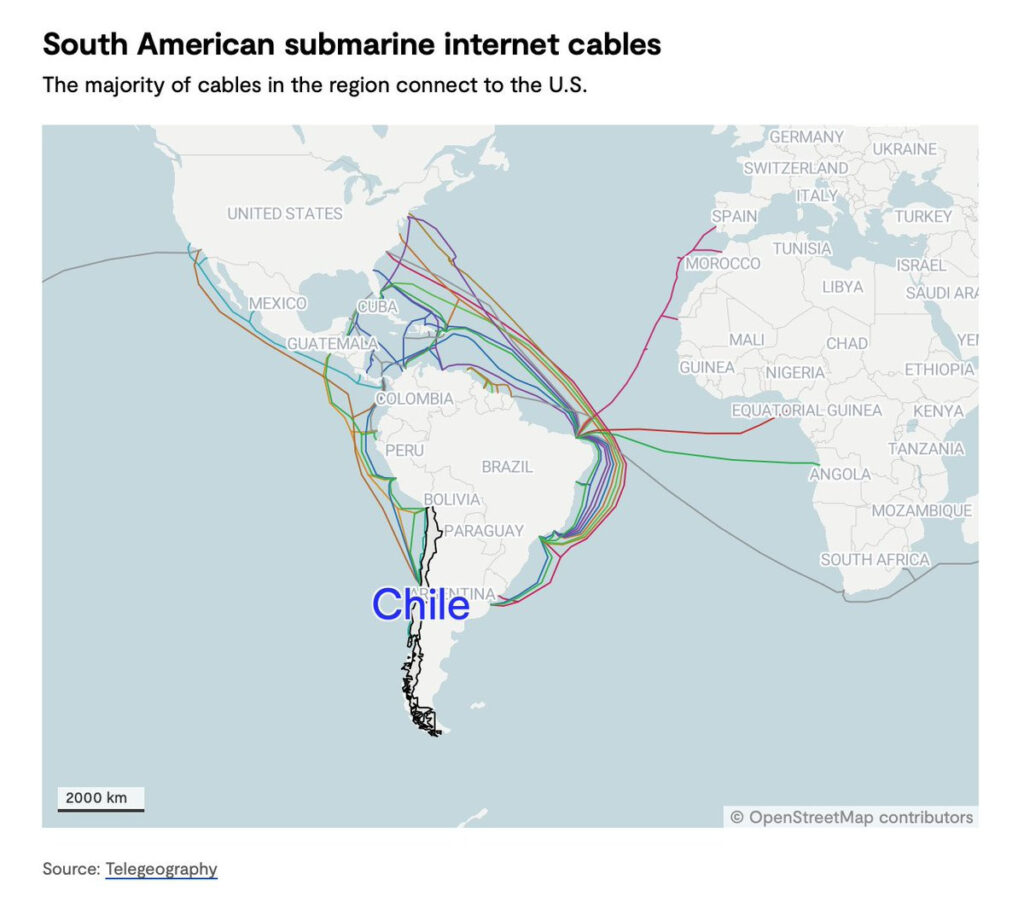
https://restofworld.org/2026/chile-china-america-google-cable
🇺🇸📡 🇨🇳[NEWS: U.S.-China Rivalry Reaches South American Skies]
“As the United States increasingly views Beijing as a rival in space, the stars above South America have become flash points in a geopolitical struggle, with top American officials trying to halt astronomy projects in the Andean deserts out of fear China could use them for military purposes.
The Trump administration says it is enforcing an updated Monroe Doctrine, in part to counter China’s growing footprint in the Western Hemisphere. China is a key trading partner for many countries in Latin America, and it is trying to build scientific and security ties. Its relations in the region could come up in official talks this week in Beijing between President Trump and Xi Jinping, China’s leader.
Last year, Argentina’s neighbor Chile stopped a Chinese astronomical observatory project in the Atacama Desert after strong urging from a U.S. ambassador. And in the case of the Cesco observatory’s Chinese radio telescope project — which would be the largest of its kind in South America — authorities have held some key, final parts for it at customs for about nine months.”
https://www.nytimes.com/2026/05/10/world/americas/us-china-telescope-argentina-chile.html
🇺🇸🇻🇪⛏️🛢️[NEWS: Venezuelan resources flowing onto the US extractive conveyor belt]
“The new geopolitical reality was on full display in early March, when US Interior Secretary Doug Burgum – accompanied by a delegation of American mining executives – travelled to Caracas as part of the White House’s efforts to get new mining legislation approved. “The opportunities for collaboration and synergies between our two great countries of Venezuela and the United States are unlimited,” Burgum said. On 27 March the US Treasury Department’s Office of Foreign Assets Control (Ofac) issued a general licence authorising transactions related to the mining and processing of minerals in Venezuela, and the entry into contingent investment contracts in the mineral sector. Not only did the US pressure Caracas to open the mining sector, multinational companies also lobbied the government and legislators to adapt the bill to their needs.”
🇺🇸[NEWS: Former Google CEO and Biden advisor, Eric Schmidt sees Chinese open source AI as undermining US control over tech diffusion]
“ [We implemented] hardware controls for chips. We were very successful collectively, all of us, to limit hardware access to China. And I was strongly in favor of this policy, as were many people. It looks like the policy has worked, but it’s largely beginning to not work. The Chinese are clever. They’re smart. Um, and they have now built systems that are within striking range of the top models in America, but with much much less powerful hardware. The technical summary is that they use a chip called the Ascend chip. it uses a slower process and they’ve invented new softer ways to get around the various latency and architectural problems. Um, what I like about this is that we have real competitors. What I don’t like about it is China is very focused on broad diffusion of this technology globally and it’s all open source which means it’s largely uncontrolled and not controlled in any way by us.…”
🇺🇸↕️🏗️[NEWS: Tech companies continue vertical integration-> OpenAI announces its first in-house chip]
“On Wednesday, OpenAI took its biggest step yet towards full technological independence with the unveiling of a new AI chip, dubbed Jalapeño, that it developed in collaboration with U.S. chipmaker Broadcom. In a blog post, the company described Jalapeño as an “Intelligence Processor” and said it moved OpenAI closer to becoming a “full-stack” AI platform”
🇺🇸[NEWS: NSA using Anthropic used for cyberattacks]
“Anthropic “installed about half a dozen staff within the NSA as so-called forward-deployed engineers to guide the use of the technology and customise models for specific applications.” “
https://t.co/sWmXvPSUy4
🇺🇸🪖[NEWS: US Department of War onboards key tech venture capitalist to tech advisory board]
“Hegseth announced that venture capitalist Marc Andreessen will serve on the board. He is the general partner at Andressen Horowitz, a firm whose investments include OpenAI, SpaceX, Skydio, Hadrian and Anduril — all companies that have contracts with the Pentagon.”
https://thehill.com/policy/defense/5946027-hegseth-announces-new-board
See also: Newsletters
🇻🇦🫂↔️🤖[News: Vatican encyclical, magnifica humanitas calls for “disarming AI” and ensuring tech development serves humanity]
“Artificial intelligence needs to be disarmed. The word [disarmed] is strong I know, but deliberately chosen because this moment needs words capable of attracting attention, awakening consciences, and indicating paths forward for humanity.”
https://www.vatican.va/content/leo-xiv/en/encyclicals/documents/20260515-magnifica-humanitas.html
See also: “Neutralising the propaganda machine: proposals for cyber-propaganda de-escalation” -> https://www.tandfonline.com/eprint/3VSGIKQQFNMBQXMCS7BR/full?target=10.1080/23738871.2026.2656182#d1e703
Key excerpts from the encyclical according to AP: https://apnews.com/article/vatican-ai-encyclical-pope-leo-excerpts-ee0de875adbdb3d599d4da2c597ff7bd
🇿🇦 [News: Ramaphosa defends South Africa’s non-aligned foreign policy]
“Cyril Ramaphosa has defended South Africa’s non-aligned foreign policy amid renewed questions in Parliament over the country’s relations with China, Russia and Iran, as well as tensions with the US over trade tariffs and diplomatic positioning.
Ramaphosa’s remarks come after US Ambassador to South Africa Leo Brent Bozell III criticised South Africa’s non-aligned foreign policy stance on X, referencing its engagements with China and Iran, including Deputy President Paul Mashatile’s visit to Beijing.”
https://www.pressreader.com/south-africa/sunday-tribune-south-africa/20260628/281990384247504
🇺🇸🇧🇷💊🛜 [Analysis: Brazil’s strategic moves on IP agreements]
“The US entered the room with a clear objective: to make the moratorium permanent — while keeping it decoupled from a permanent renewal of the intellectual property moratorium. In other words, doing a favour for Big Tech and Big Pharma, all at once. In the months prior, the US had been gathering allies: many of the trade agreements signed by the Trump administration already included a clause committing the signatory country to support the US position at the WTO. A kind of pre-agreement not to oppose their interests in the future.
The day of the WTO session arrived and the result was clear-cut: 46 countries expressed support for the US position; 57 countries backed extending both moratoriums for two years (as had been the usual practice); 6 supported a four-year renewal; and 16 countries stated they were willing to negotiate but would not under any circumstances accept a permanent moratorium. Trump’s plans appeared to be failing.
Even so, the following day a five-year agreement seemed within reach. Countries were gradually yielding, and the US was heading home without exactly what it wanted but satisfied enough with the result. Then Brazil pushed back. Or rather, let’s correct the term: it didn’t simply push back — it saw a window of opportunity to get something else…”
https://www.tni.org/en/article/the-night-brazil-said-no-to-trump-and-changed-the-internet-forever
🇦🇪🇸🇦🇶🇦[Analysis: “The new non-alignment: How the Middle East is carving out room to maneuver in AI”]
The United Arab Emirates is building the infrastructure node for a Global South disinclined to inherit any single superpower’s technology stack. Saudi Arabia is embedding AI into the productivity logic of its Vision 2030 plan through the Saudi Data and Artificial Intelligence Authority, channeling oil giant Aramco’s decades of proprietary data into industrial coordination. Qatar is positioning around AI governance and diplomatic convening, an architecture no multilateral institution has yet credibly constructed. Three states converging on three different layers of the same opportunity by separate calculation, not design, is the more interesting development. The talent pipeline remains the binding constraint, and the region knows it….” https://www.atlanticcouncil.org/blogs/menasource/the-new-non-alignment-how-the-middle-east-is-carving-out-room-to-maneuver-in-ai/
🇮🇳 [Analysis: India, muti-alignment, autonomy and Washington]
“However, the “alignment” in New Delhi’s “multi-alignment” is clearly different from both the Non-Aligned Movement and alliance structures in the US-led system. This “multi-alignment” means making decisions to align or not align on different issues according to one’s own national interests, with the aim of effectively managing multiple major-power relationships. A typical example is India’s response to the ongoing Russia-Ukraine conflict: It has refused to follow the US and its Western allies in sanctioning Russia, continuing Russian oil purchases and bilateral economic and trade cooperation, while striving to sustain sound ties with Washington. Yet in practice, this balancing diplomacy has struggled to prevent India’s varied diplomatic “alignments” from conflicting with one another, contrary to New Delhi’s expectation of “mutual non-interference.”
It is thus evident that, whether under the INC’s “non-alignment” policy or the current government’s emphasis on “multi-alignment,” the underlying principle guiding New Delhi remains the pursuit of strategic autonomy and the safeguarding of national interests.
Based on this logic, India should not wait for “reassurance” from any external power; instead, it should reassess its own strategic situation and move more quickly and decisively toward adjustments that genuinely advance its strategic autonomy and serve its core national interests.” https://www.globaltimes.cn/page/202606/1362601.shtml
🤖 [Analysis: The values embedded in AI chatbots]
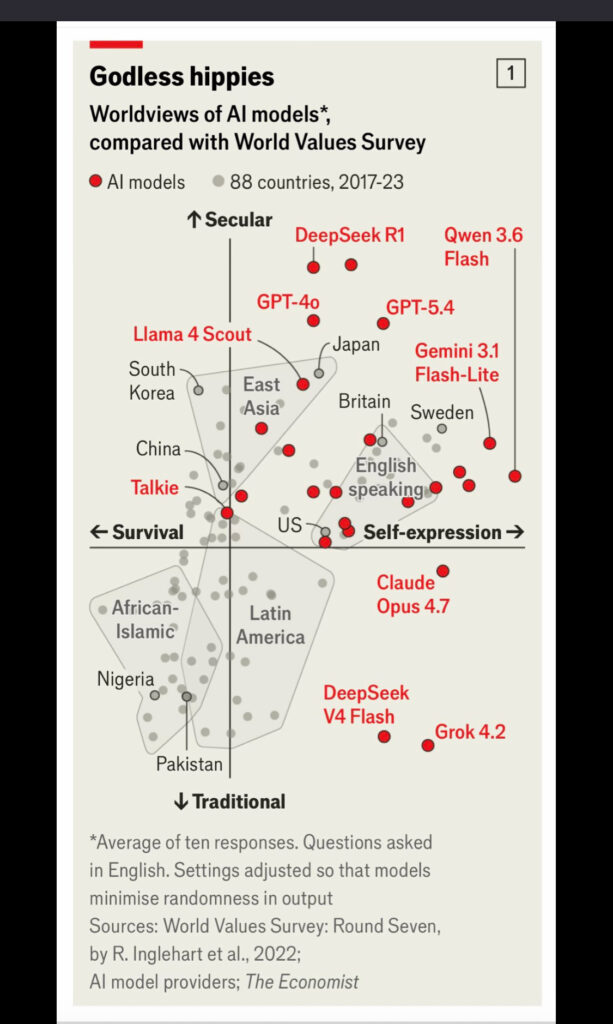
Via The Economist [unpaywalled here]
🇪🇺[Analysis and advocacy: Europe 2031
“Europe 2031 is a five-year scenario about Europe’s impending slide into irrelevance: how AI is driving it, and what can still be done to change course.”
RESEARCH FROM WITHIN THE NETWORK:
📄☁️📰[New article by Agustin Ferrari Braun, Universiteit van Amsterdam (Media Studies), a.l.ferrraribraun@uva.nl]
- Ferrari Braun, A. (2026). “Reliable and Cheap”?: Examining the adoption of the cloud by European news media companies. Media, Culture & Society. https://journals.sagepub.com/doi/10.1177/01634437261442045
“Since the middle of the 2010s, an overwhelming majority of European news media companies have adopted cloud infrastructures. While a growing number of scholars and policymakers are raising concerns regarding the implications of cloud dependence, a systemic exploration of why media companies decided to undergo such infrastructural transformation is still missing. Building on 41 semi-structured interviews with news media professionals in France and the Netherlands, the present contribution shows that the move to the cloud was justified by the supposed reliability and cheapness of these infrastructures. Unpacking what is meant by those categories, the present paper shows how the infrastructure, labour practices, and workforce of news media companies has adapted itself to the cloud, normalising new forms of infrastructural dependence. The paper then goes on to show that conceptualising these changes through the categories of reliability and cheapness inscribes them within the traditional socio-technical imaginaries of media infrastructure, foregrounding their invisibility. However, doing so also obscures the unequal power relations between cloud providers and news media companies.”
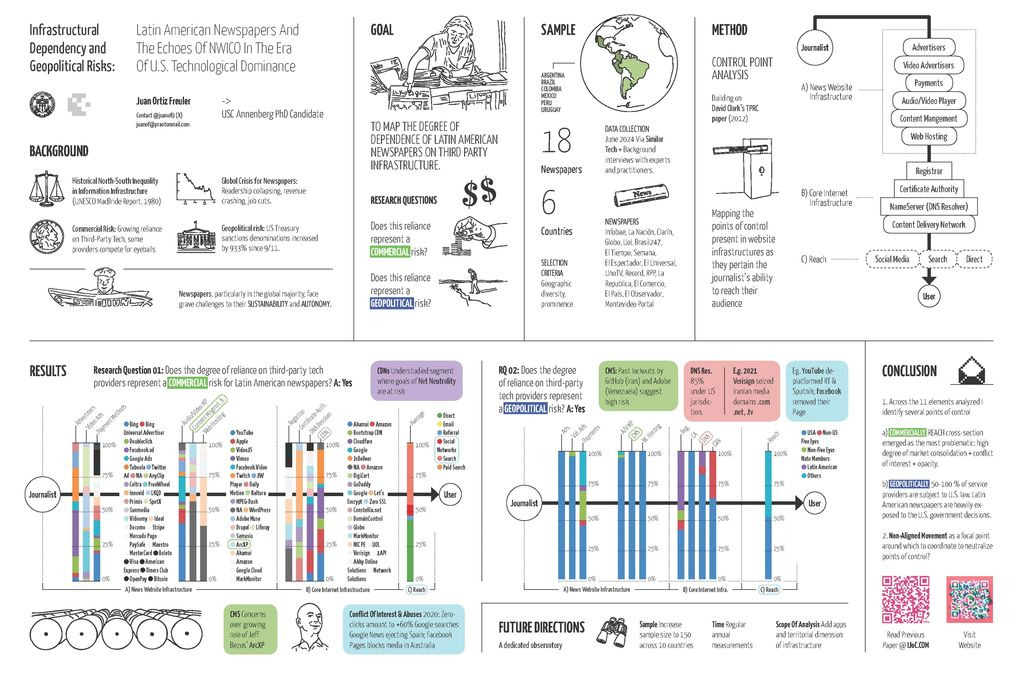
📄🏗️📰[New article by Juan Ortiz Freuler, University of Southern California, Annenberg School for Communication, juanof@protonmail.com]
Ortiz-Freuler, J. (2026). Informational Sovereignty: The Commercial and Geopolitical Risk of Newsroom Dependency on Third-Party Infrastructure in Latin America. International Journal of Communication, 20, 26-26.https://ijoc.org/index.php/ijoc/article/view/26272/5325
“This article reveals significant market consolidation within the digital infrastructure of Latin American media. Extending the political economy of media literature from ownership to control over underlying infrastructure, it uses a newly constructed database of over 400 data points to analyze the online infrastructure of 18 media outlets across 6 Latin American countries, focusing on 11 key elements of the media stack. Findings indicate that dominant players, such as Alphabet and Meta, pose the greatest commercial risks to the analyzed media. Meanwhile, the U.S. government emerges as the greatest geopolitical risk, with 50–100% of providers across the analyzed elements operating under U.S. law, exposing Latin American media with similar infrastructural profiles to U.S. government policy. The article places these challenges in conversation with historical calls for a New World Information and Communication Order, which underlines that a robust understanding of media autonomy requires infrastructural autonomy.”
UPCOMING NATM EVENTS
- 🗣 🍁 October 7-10- Toronto: Panel at the Society for Social Studies of Science (4S) in Toronto (October): “How can the study of dependency theory enhance digital sovereignty?” – co-organized by Guilherme Cavalcante Silva, Paola Ricaurte, Marco Trigoso, Raúl Zambrano, and Juan Ortiz Freuler.
- 🗣 🇲🇽 Mexico City–> Oct 13-17:
- Pre-conference workshop on Dependency Theory and Non-Alignment at the Association for Internet Researchers (AoIR)) taking place in Mexico City.[led by Luciana Musello and members of the NATM dependency theory working group)
- Panel on the Non-Aligned Tech Movement at the Association for Internet Researchers (AoIR) taking place in Mexico City. [Chaired by Ulises Mejias and Juan Ortiz Freuler].
Did a friend forward you this newsletter? Sign up here to get the NATM newsletter in your inbox!